ISSR CLASSES
Checkpoint Science
iGCSE Chemistry
iGCSE Physics
iGCSE Coordinated Science
A-Level Chemistry
PRACTICALS
Practicals Home
Practicals A-Z
Study Plan for Practical Work
Benzene and delocalisation
|
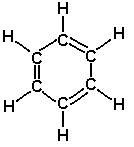
The formula of benzene, C6H6, has been known for some time, and it was Kekulé who first suggested the structure opposite that accounts for the bonding. However, a number of problems cast doubt on this theory. This structure has three double bonds, so we might expect that it should react like the alkenes do. However, we find that it is much less reactive, and very reluctant to undergo addition reactions with the same ease that the alkenes do. When it does react, it does so generally by substitution, where one of the hydrogen atoms is replaced by another atom or group of atoms. When the structure is examined by X-ray diffraction it is found that all the carbon-carbon bond lengths are the same - longer than a double bond, but shorter than a single bond. |
|
Both ethene and benzene can be made to react with hydrogen gas to form ethane and cyclohexane respectively. In the case of ethene, a C=C double bond and an H-H single bond are replaced by a C-C single bond and two C-H single bonds:
|
CH2=CH2 + H2 ⇒ CH3CH3 |
DH = - 136.9 kJ mol-1
When benzene reacts with hydrogen, it appears that the same types of bond are broken and formed, but three times as many. So we would expect the enthalpy change to be three times greater:
|
|
DH = - 205.3 kJ mol-1
However, it is not three times the value, it appears to be more stable than we would expect by 205.4 kJ mol-1 (3 ´ - 136.9 kJ mol-1 - - 205.3 kJ mol-1). This suggests that the bonding in benzene is not how we have represented it.
|
|
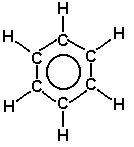
This is explained by the concept of delocalisation. It is thought that we do not have three sets of four electrons localized in three double bonds, but that each of the carbons is joined to its neighbour by a pair of localized electrons (a single bond). The other six electrons (from three double bonds) are free to move between all the bonds in two rings above and beneath the carbon atoms. As a result each carbon-carbon bond has the same share in all the electrons, each of these bonds is, therefore, like a bond and a half, and this explains the identical bond lengths discovered by X-ray diffraction. Allowing the electrons to spread out in this way lowers their energy as they repel each other - it's a bit like letting a coiled spring unwind. This lower energy explains the odd DH values, and why benzene is more reluctant to react than the alkenes. You should now understand why benzene is often represented by a hexagon with a ring in it. |
Because of the high electron density in the benzene ring, arenes react with molecules known as electrophiles (electron lovers). Consequently, any side chain can have an effect on the reactivity of the benzene ring itself. Groups that release electrons into the ring will increase its electron density and make the ring more reactive towards the electrophiles it usually reacts with. A group that has a lone pair of electrons immediately adjacent to the ring will release electrons into it, and have the effect of increasing its reactivity. The methoxy group present in methoxybenzene has such a lone pair on the oxygen atom, and so we observe an increased reactivity with this molecule.