ISSR CLASSES
Checkpoint Science
iGCSE Chemistry
iGCSE Physics
iGCSE Coordinated Science
A-Level Chemistry
PRACTICALS
Practicals Home
Practicals A-Z
Study Plan for Practical Work
|
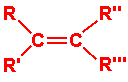
The alkenes are hydrocarbons which contain one or more double bonds. Alkenes are much more reactive than the alkanes, reacting readily by addition. The general formula on the right shows the structure of an alkene. The R groups represent any groups of atoms. |
|
The simplest of the alkenes is ethene. This is a very important chemical as it is used in the production of the plastic, poly(ethene) more commonly known as polythene.
Alkenes have the suffix -ene, giving a name of the type alkene. With the larger alkenes a number needs to be used if there is more than one place that the double bond could be. We use the smallest number of the two carbon atoms that the double bond joins.
Examples
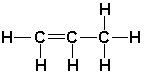
The structural formula is CH2=CHCH3
This has three carbon atoms and a double bond. The name is propene. There is no need for a number to identify the double bond as it only has one possible position. If you put the double bond between the other two carbon atoms you still have the same molecule. It's just like looking at it from the other side of the screen.
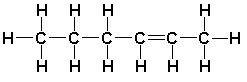
The structural formula is CH3CH2CH2CH=CHCH3
With six carbon atoms and a double bond between the second and third carbon atoms, this molecule is called hex-2-ene. Note that we counted from the right hand side in order to give the smallest number. Hex-1-ene and hex-3-ene are possible isomers with the double bond in different positions. This molecule has geometric isomers which will affect the naming.
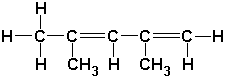
The structural formula is CH3C(CH3)=CHC(CH3)=CH2
The name is 2,4-dimethylpenta-1,3-diene. Check out the use of punctuation, and note again that we have numbered the molecule so as to give the smallest numbers.
|
|
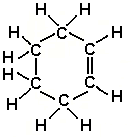
A ring of six carbon atoms is called cyclohexane. With a double bond present it is called cyclohexene. There is no need for a number as all the positions are equivalent. Check out the number of hydrogen atoms present in order to give the correct bonding - students often make mistakes here. |
|
|
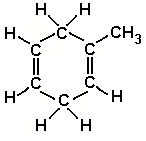
This is another cyclic alkene. This time we do need numbers in order to make the relative positions of the double bonds and methyl side chain clear. This is called 1-methylcyclohexa-1,4-diene. The methyl group is given as position 1 in order to give the smallest numbers. |
Alkenes are considerably more reactive than the alkanes as they can react by addition. The molecules are non-polar so are immiscible with water.
Exercise
|
In this exercise we shall be using cyclohexene. Cyclohexene is a highly flammable liquid with a fairly unpleasant smell. Watch the videos and make observations. Check your answers using the link at the end of the page. When attempting to draw the structures of the product molecules it is worth bearing in mind that alkenes generally react by addition. |
|
|
cyclohexene |
1. Combustion
Watch the video and describe the combustion that you see. Try to explain your observations. Assuming the normal products for complete combustion, write a balanced equation for the combustion of cyclohexene.
Always remove the combustion spoon from the Bunsen flame once the liquid has ignited. Students often leave it in the Bunsen and this makes it difficult to see how it is burning.
Video - the combustion of cyclohexene
2. Oxidation
We use a solution of potassium manganate(VII), well acidified with dilute sulfuric acid. Describe the reaction which takes place. How does this compare with the reaction for the alkanes? Suggest a formula for the product. The answer is not obvious. It may help you to know that a molecule of water is involved in the addition reaction along with something from the oxidizing agent.
Video - reaction of acidified manganate(VII) ions with an alkene
3. Action of bromine
This is the standard test for unsaturation (presence of double/triple bonds). Make your observations from the video. Draw out the displayed formula for the product.
Video - reaction of bromine water with an alkene
4. Polymerization
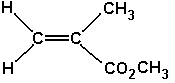
This reaction is an example of addition polymerization. It is started using a free radical initiator called didodecanoyl peroxide. In this reaction the monomer methyl 2-methylpropenoate is polymerized to give the polymer poly(methyl 2-methylpropenoate), otherwise known as Perspex. Having checked the theory, try to draw out the structure of the polymer showing two complete monomer units.
|
|
Structure of methyl 2-methylpropenoate monomer |
Video - the polymerization of methyl 2-methylpropenoate
You may notice in the video that the bottle of methyl 2-methylpropenoate is labelled methyl methacrylate. This is the old non-systematic for the chemical.