ISSR CLASSES
Checkpoint Science
iGCSE Chemistry
iGCSE Physics
iGCSE Coordinated Science
A-Level Chemistry
PRACTICALS
Practicals Home
Practicals A-Z
Study Plan for Practical Work
|
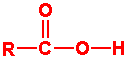
Carboxylic acids have the general formula, RCOOH (where R represents any group of carbon and hydrogen atoms). The old name for larger carboxylic acids is fatty acid (you may still meet this in biology). |
|
|
|
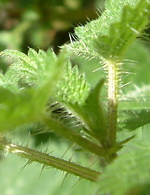
The group's structural formula can be written as RCOOH or RCO2H, and I shall use the two interchangeably. Methanoic acid (formic acid) is found in ants and nettles Ethanoic acid (acetic acid) is found in vinegar |
Carboxylic acids have the suffix -oic acid, giving a name of the type alkanoic acid. There is no need for any position number as carboxylic acid groups can only be placed at the end of a chain (there are not enough bonds in the middle!).
Examples
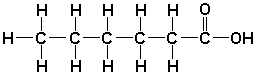
The structural formula is CH3(CH2)4COOH or CH3(CH2)4CO2H
This has the carboxylic acid group (COOH) and six carbons, so is called hexanoic acid. The old name is caproic acid, and it smells of goats, nice!
|
|
The structural formula is CH3CH2CH2COOH This is butanoic acid. Hope you weren't conned! There is a straight chain of four carbons which just bend around the corner. There is no side chain. The old name for butanoic acid is butyric acid - it smells of rancid butter, even nicer! |
|
|
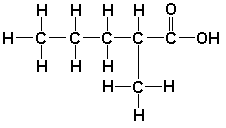
The structural formula is CH3CH2CH2CH(CH3)CO2H The name is 2-methylpentanoic acid. Be careful with the numbering - the carboxylic acid carbon is always assumed to be carbon number 1. |
|
|
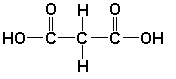
The structural formula is HO2CCH2CO2H This has two acid groups and three carbons in the chain (you do need to include the carbon atoms which are in the carboxylic acid groups). So the name is propanedioic acid. |
|
|
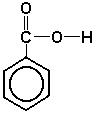
The structural formula is C6H5CO2H This molecule contains a benzene ring. It's systematic name is benzene carboxylic acid, but it is more commonly known as benzoic acid. |
|
|
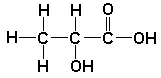
The structural formula is CH3CH(OH)CO2H The alcohol functional group has to be named using a prefix as the acid name is taking up the end position. This molecule is called 2-hydroxypropanoic acid (lactic acid). |
Ethanoic acid is readily soluble in water due to the effect of hydrogen bonding. Draw a diagram to show the interaction between the two molecules. You should also be able to write down an equation for the reaction with sodium carbonate solution, and explain why ethanoic acid has an acidic nature.
Theory - solubility and pH of ethanoic acid
Carboxylic acids are generally weak acids, but any attached groups can affect the strength of the acid.
As carboxylic acids are acids, they react with alkalis to form salts. For example, ethanoic acid reacts with sodium hydroxide to form the salt, sodium ethanoate:
|
CH3COOH(l) + NaOH(aq) ⇒ CH3COONa(aq) + H2O(l) |
|
|
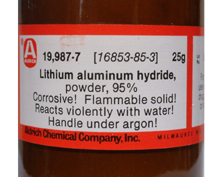
This reaction uses the powerful reducing agent, lithium tetrahydridoaluminate (otherwise known as lithium aluminium hydride, LiAlH4). You are unlikely to carry out the reaction in practical, but you may meet it in your exam. Carboxylic acids are reduced to the corresponding primary alcohols. The reaction is easiest to write down using [H] to represent the hydrogen from the reducing agent: |
|
|
RCOOH + 4[H] ⇒ RCH2OH + H2O |
You should also know the reverse reaction in which a primary alcohol is oxidized to a carboxylic acid.