ISSR CLASSES
Checkpoint Science
iGCSE Chemistry
iGCSE Physics
iGCSE Coordinated Science
A-Level Chemistry
PRACTICALS
Practicals Home
Practicals A-Z
Study Plan for Practical Work
Hydrogen bonding
This is the name given to a particularly strong type of intermolecular force. Intermolecular forces act between different molecules of a substance, so raising the melting and boiling points. Intramolecular forces act within the same molecule, and hydrogen bonding can be responsible for these forces too. Usually these forces are quite weak, but hydrogen bonds are relatively strong, with about 10% of the strength of a covalent bond.
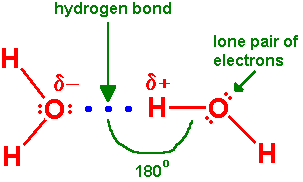
Hydrogen bonds are a special case of dipole-dipole interaction. They nearly always involve one of three groups - O-H, N-H or F-H. As F-H only occurs in the HF molecule, we are usually concerned with O-H or N-H bonds. These bonds are polar, as the N, O or F atoms are more electronegative than the hydrogen atom. This means that the N, O or F atom will be slightly negative (indicated by d-, delta minus) and the hydrogen atom is slightly positive (indicated by d+, delta plus). This is the usual situation in dipole-dipole interactions, the d- in one molecule attracts the oppositely charged d+ in an adjacent molecule.
|
You are often asked on the exam to draw a diagram to illustrate hydrogen bonding between molecules like water. Note that the O-H-O bond angle is 180°. The interaction is always between a positive hydrogen atom (therefore, NOT a C-H hydrogen which is non-polar) and the lone pair of electrons on an O, N or F atom. This means that we don't need an OH, NH or FH in both molecules for hydrogen bonding to occur between them, but this gives the strongest bonding. Though, we must have a positive hydrogen atom in one molecule and an O, N or F atom in the other. |
|
The reason for the unusual strength of hydrogen bonding is that we are involved with the hydrogen atom (perhaps not surprising, but this fact does elude some students!). The hydrogen atom is the smallest atom on the Periodic Table, and O, N and F are also fairly small atoms. This means that the d- and d+ can approach very closely, where the attraction between them will be particularly strong.
Hydrogen bonding is responsible for a number of important phenomena. One of these is the anomalously (unusually) high boiling points of the hydrides which contain the above bonds:
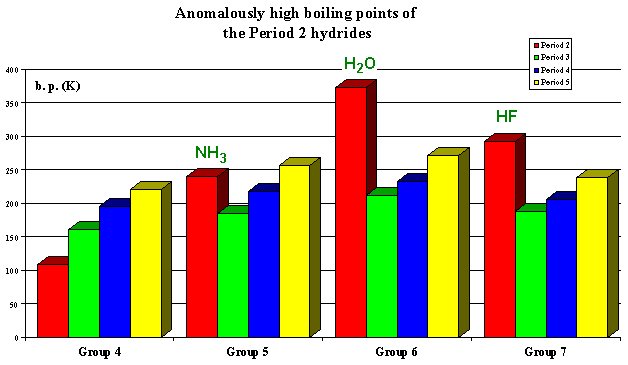
The chart above shows how the NH3, H2O and HF molecules all have unusually high boiling points - they go out from the expected pattern. You should see that the water shows the greatest deviation from the expected pattern. Try to work out why this is so. The bond polarity increases in the sequence N-H, O-H, F-H because of the increasing electronegativity. The clue is in the diagram showing hydrogen bonding in water above. Check your answer here .
|
|
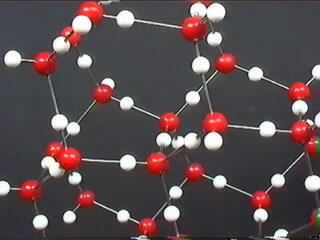
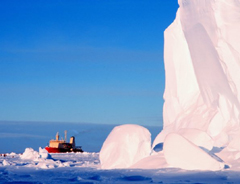
Hydrogen bonding is also important in the structures of materials like ice and hydrated salts. Ice is an unusual substance in that the solid is less dense than the liquid, and so ice floats on water. This is because hydrogen bonds in the solid ice give it a very open, low-density structure. |
|
Hydrogen bonds are also responsible for the high viscosity of polyhydric alcohols (these have more than one OH group). Thus, propan-1-ol has a low viscosity (it's runny!), whereas propane-1,2,3-triol (glycerine) is very viscous. This is because the large number of OH groups in the glycerine hydrogen bond to those in adjacent molecules. |
|
The high surface tension of water, which allows us to float a steel needle on the surface, is due to hydrogen bonding. Hydrogen bonding also determines the shape of complex biological molecules like DNA and enzymes.
The broad infra-red absorption of O-H and N-H groups is another consequence of hydrogen bonding. The formation of a hydrogen bond affects the strength of the O-H or N-H bond. This gives a range of bond strengths and a consequent range of vibration frequencies for the groups.