ISSR CLASSES
Checkpoint Science
iGCSE Chemistry
iGCSE Physics
iGCSE Coordinated Science
A-Level Chemistry
PRACTICALS
Practicals Home
Practicals A-Z
Study Plan for Practical Work
A catalyst speeds up the rate of a chemical reaction but can be recovered chemically unchanged at the end of the reaction. Have a look at this demonstration. The transition elements and their compounds make good catalysts.
Reactions with a high activation energy will only progress slowly at moderate temperatures. We could raise the temperature to speed up the rate of reaction, but in a commercial setting the heat needed costs money. Ideally we would obtain a higher reaction rate without having to raise the temperature. This can be done using a catalyst, and consequently a lot of research effort goes into finding suitable catalysts for chemical reactions.
|
A catalyst provides an alternative reaction pathway of lower activation energy. |
Consequently, a greater proportion of molecules will possess the activation energy at a given temperature, so the reaction rate increases as there are more successful collisions:
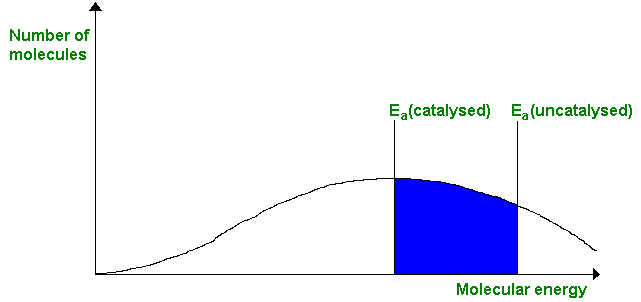
The blue area shows the number of extra molecules which will have the necessary activation energy on adding the catalyst.
|
|
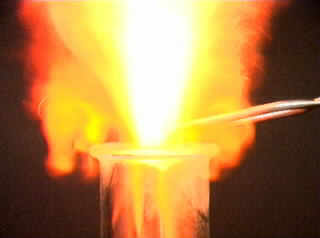
The picture shows the use of a platinum catalyst on a gas jar of hydrogen. The reaction between hydrogen and oxygen has too high an activation energy to take place at room temperature. The addition of the platinum catalyst lowers the activation energy and the reaction takes place (explosively!). |
Some reactions produce their own catalysts - an effect known as autocatalysis.
If a catalyst is in the same phase as the reactants that it is catalyzing it is known as a homogeneous catalyst. Two examples are seen in the demonstration above. If the catalyst is in a different phase to the reactants which it is catalyzing it is known as a heterogeneous catalyst. A common type is a metal catalyst catalyzing a gas reaction as in the photograph above.