ISSR CLASSES
Checkpoint Science
iGCSE Chemistry
iGCSE Physics
iGCSE Coordinated Science
A-Level Chemistry
PRACTICALS
Practicals Home
Practicals A-Z
Study Plan for Practical Work
This is the only common alkaline gas met at "A" Level. It is colourless, very soluble in water and has a familiar choking smell (of stale urine). It turns damp, red litmus paper blue. In the presence of hydrogen chloride gas a dense white smoke of solid ammonium chloride forms:
|
NH3(g) + HCl(g) ⇒ NH4Cl(s) |
Video - testing for a hydrogen halide with ammonia
An open bottle of concentrated hydrochloric acid is a convenient source of hydrogen chloride gas.
|
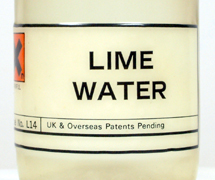
Limewater is calcium hydroxide solution. It is a sparingly soluble alkali which is usually used to test for carbon dioxide gas. A positive test for the gas is given when the limewater turns milky. However, if carbon dioxide gas continues to pass through the limewater it will go clear again. These changes are due to a pair of chemical reactions. The first produces calcium carbonate which is insoluble, and it is this which causes the milkiness: |
|
|
Ca(OH)2(aq) + CO2(g) ⇒CaCO3(s) + H2O(l) |
This is followed by a further reaction producing a solution of calcium hydrogencarbonate which is soluble, and so the milkiness clears:
|
CaCO3(s) + H2O(l) + CO2(g) ⇒Ca(HCO3)2(aq) |
|
|
This last reaction is reversible and is responsible for the formation of stalagmites and stalactites in nature. Rainwater, containing carbon dioxide gas, passes over limestone (calcium carbonate) forming calcium hydrogencarbonate solution according to the second equation. This drips from the roofs of caves and, either on the roof or the floor below, evaporates and the second reaction takes place in reverse. This forms insoluble calcium carbonate which makes up the stalactite or stalagmite over many thousands of years. |
Video - the limewater test for carbon dioxide
|
Students sometimes suggest that carbon dioxide can be tested for using a burning splint which will become extinguished (carbon dioxide is used in fire extinguishers). However, this is not a satisfactory test. Try putting a burning splint in a test tube full of air - it will quickly go out. The burning splint uses up all the oxygen and fresh gas cannot get into the test tube fast enough. Consequently it goes out - whether or not the test tube contains carbon dioxide! |
|
|
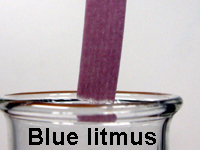
Chlorine is a pale green, toxic gas with the characteristic smell of swimming baths (where it is used as a sterilant). It can be tested for using damp blue litmus paper. The paper first turns red showing an acidic nature and is then bleached white. Click once on the image on the right to see this sequence. |
|
|
|
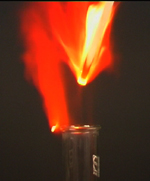
This burns with a squeaky pop when a lighted splint is used. |
These colourless acidic gases are all very soluble in water and fume in moist air. They turn damp, blue litmus paper red. In the presence of ammonia gas a dense white smoke of solid ammonium halide forms:
|
NH3(g) + HCl(g) → NH4Cl(s) |
Video - testing for a hydrogen halide with ammonia
|
This extremely poisonous gas smells of rotten eggs. It turns lead(II) ethanoate (old name, lead acetate) paper black. This is due to the formation of black lead(II) sulfide. You should remember that lead salts are toxic. |
|
Video - testing with lead ethanoate paper
|
|
This is an acidic, brown gas. The production of a brown gas from a nitrogen-containing material, like a nitrate, suggests that it will be nitrogen dioxide. This can be checked by testing with damp blue litmus or damp full range indicator paper. Both of these will turn red, indicating an acidic gas. This is a very toxic gas - do not attempt to smell it. |
Sulfur dioxide is a colourless, acidic gas and sulfur trioxide is a colourless, acidic liquid with a low boiling point. Both are major causes of acid rain. We can test for these gases using damp blue litmus or damp full range indicator paper. Both of these indicators will turn red with acidic gases. There are many colourless, acidic gases, so this is not an exclusive test for sulfur dioxide and sulfur trioxide. However, if the source of the acidic gas contains sulfur, as in a sulfate, it seems likely that the gas will be an oxide of sulfur. These gases are hazardous, particularly to people with breathing difficulties, like asthma.
Video - testing with full range indicator paper
|
A further test for sulfur dioxide is based on its reducing qualities. It will turn filter paper soaked in acidified potassium dichromate(VI) solution from orange to green. |
|
A less common alternative is to use filter paper soaked in acidified potassium manganate(VII) solution. The purple colour is decolourised by sulfur dioxide gas.
Things burn very well in pure oxygen. A glowing splint will re-light in this gas. Air only contains around 21% oxygen.
|
|
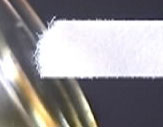
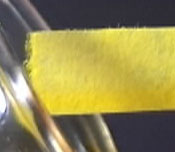
Many crystals contain water of crystallization, like the well-known blue copper sulfate crystals, CuSO4.5H2O. This water is chemically attached to the crystal in a fixed proportion. On heating in a test tube, this water is released as steam. The steam will condense higher up the test tube and can be seen as droplets of colourless liquid. It is possible that droplets of colourless liquid could be some material other than water, but water is by far the most likely colourless liquid you will observe. Water can be confirmed by testing with cobalt chloride paper, which is blue. This turns pink in the presence of water. |



_chloride_paper.JPG)