ISSR CLASSES
Checkpoint Science
iGCSE Chemistry
iGCSE Physics
iGCSE Coordinated Science
A-Level Chemistry
PRACTICALS
Practicals Home
Practicals A-Z
Study Plan for Practical Work
|
|
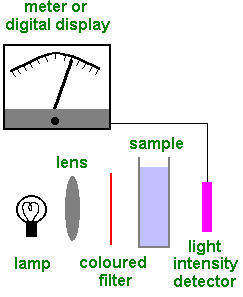
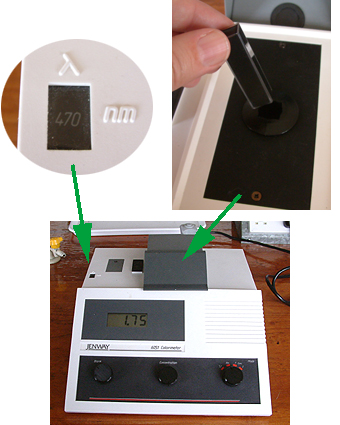
This is the technique of using the depth of colour of a substance in order to measure its concentration. We use a machine called a colorimeter to measure the depth of colour of a solution. The machine is calibrated by checking a series of different known concentrations of solution. From the readings we construct a graph of absorbance (the percentage of light absorbed by the sample) against concentration - this is known as a calibration curve. We can then read off the graph the concentration value that goes with the absorbance value for our unknown solution. |
|
We need to understand a little bit of the physics of colour. Taking an example of blue aqueous copper(II) sulfate solution. This solution appears blue because white light enters and blue light is not absorbed (otherwise there would be no blue to see). It is the other colours that are absorbed. So if we were running some samples of copper(II) sulfate in a colorimeter we might put in a red filter and measure how much red light is absorbed. The higher the concentration of copper(II) sulfate, the higher the absorbance of the red light will be. The machine may be set by the wavelength of the light involved. Visible light wavelengths vary from around 400 nm (blue) to 700 nm (red). |
|
Many substances are colourless, but we can still use colorimetry to measure their concentrations. We could investigate an area of the non-visible spectrum - it may well absorb in the uv (ultra-violet) region. Alternatively, we can react the material with something which gives a coloured product. The product concentration is then measured by colorimetry and this is related to the concentration of the original material.
Colorimetry can be used in the measurement of rates of reaction.