ISSR CLASSES
Checkpoint Science
iGCSE Chemistry
iGCSE Physics
iGCSE Coordinated Science
A-Level Chemistry
PRACTICALS
Practicals Home
Practicals A-Z
Study Plan for Practical Work
This is a very popular area of chemistry for both exams and practical assessments. The first technique involves measuring the rate and therefore the order of a reaction. The second technique is the determination of an activation energy.
We can measure rate of reaction by looking at how quickly a product is produced or how quickly a reactant is used up. We measure the concentration of a particular reactant or product at regular intervals throughout the reaction, and then plot a graph of concentration against time. The rate of reaction at a particular moment is the gradientof this graph at that point. The units must therefore be mol dm-3 s-1.
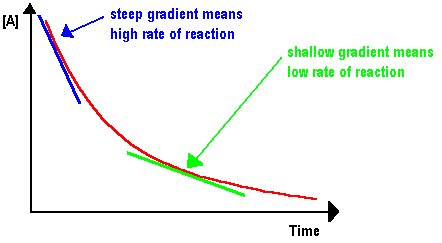
The graph above shows how the concentration of a reactant A (this is written as [A]) decreases as the reaction proceeds (the red line). The rate of reaction, seen from the gradient of the graph, is high at the start of the reaction when the concentration of A is high. The rate decreases as the concentration of A decreases. The shape of these concentration-time graphs tells us the order of reaction. If we are investigating the effect of concentration on rate it is very important to control other variables, especially temperature which has a significant effect on rate.
In order to obtain the concentration data it is important to choose a reactant or product for which it is easy to measure the concentration. There are a number of ways in which this can be done:
a) Quench and titrate
If there is a suitable substance which can be titrated, then the reaction can be run, and at regular intervals a small sample can be removed for titration. However, the reaction will still be continuing in this small sample after it has been removed, and if your titrations are not done with speed this will lead to inaccuracies in timing. This problem is solved by quenching the reaction. This usually involves rapidly cooling the sample to slow down the rate of reaction, although sometimes, if there is a catalyst present, this can be removed instead. If you are asked how to measure a reaction rate and you decide to use the quench and titrate method it is important that you say which reactant/product that you are going to titrate, what with and with which indicator. The following is a reminder of some easy titrations:
ACID: titrate with sodium hydroxide solution, use suitable pH indicator
ALKALI:titrate with hydrochloric acid, use suitable pH indicator
IODINE: titrate with sodium thiosulfate, use starch indicator
Quench and titrate experiment.
b) Colorimetry
If one of the reactants or products is coloured then we can use the technique of colorimetry. This uses a device called a colorimeter to measure the amount of light absorbed by the coloured solution. By calibrating the colorimeter with solutions of known concentration we can use the readings from this device to measure the concentration at a particular time. Being an electrical device it can be linked up directly to a computer which can take very frequent readings and automatically plot the graph. Remember, however, that a blue solution does not absorb blue light - it lets it through, otherwise it wouldn't be blue! In this case a red or a green filter would be placed in the colorimeter as these are the colours a blue solution absorbs.
c) Reactions involving gases
These reactions are relatively easy to follow as we can use the rate at which the gas is produced to measure the rate. This can be done by measuring the volume of the gas in a gas syringe or by measuring the mass lost on a digital balance. The last method allows balance readings to be logged by computer and a graph automatically plotted:

Experiment - rate of a gas loss reaction
d) Other methods
If a molecule has a chiral centre a polarimeter can be used to measure its concentration. If ions are involved conductivity could be used.
If there is a change in conductivity, then a conductivity meter could be used to measure the change. A change of conductivity would occur if ions are produced or lost. For example, in the following reaction there is little ionization in the reactants, but the hydrochloric acid produced is highly ionized (its a strong acid) and so highly conducting:
|
C3H7Cl(l) + H2O(l) ⇒ C3H7OH(aq) + HCl(aq) |
|
|
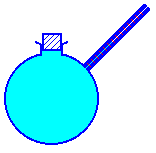
If all else fails, then the technique of dilatometry can be used. This relies on the fact that in a reaction involving only liquids there will be a small, but measurable, change in volume as the reaction proceeds. It can be measured in a dilatometer - this is a large reaction vessel attached to a very fine capillary tube. As the reaction proceeds and the volume changes, the liquid reactants either rise or fall in the capillary tube. The speed at which this occurs is a measure of the rate of reaction. Temperature control is very important in these experiments, as a change in temperature will cause the liquid reactants to expand or contract, and so move along the capillary tube. |
An alternative method to plotting a graph of concentration against time is the method of initial rates for determining order of reaction.
Experiment - method of initial rates
The second technique which you may meet in practical work is the determination of the activation energy for a reaction. This is done by measuring the rate of the reaction at a number of different temperatures.
Experiment - measuring an activation energy