ISSR CLASSES
Checkpoint Science
iGCSE Chemistry
iGCSE Physics
iGCSE Coordinated Science
A-Level Chemistry
PRACTICALS
Practicals Home
Practicals A-Z
Study Plan for Practical Work
Complex ions are central metal ions to which a number of ligands are datively bonded. A ligand is a negative ion, or a neutral molecule, with a lone pair of electrons. Common examples include H2O, NH3, OH -, Cl - and CN -. You will have seen complex ions before. The familiar blue colour of copper(II) sulfate solution is not that of the copper(II) ion, which is colourless, but that of the hexaquocopper(II) ion, [Cu(H2O)6]2+, which is blue.
Complex ions undergo reversible ligand replacement reactions, in which one set of ligands is replaced by another. This is usually accompanied by a colour change, as the complex ions are different colours. In the following example, the water in the blue, hexaquocopper(II) ion is replaced by chloride ions to give the green tetrachlorocuprate(II) ion:
|
[Cu(H2O)6]2+(aq) + 4Cl-(aq) |
|
[CuCl4]2-(aq) + 6H2O(l) |
This reaction can be reversed by adding water to the newly formed, green solution. The ease with which this happens, and consequently the volume of water required, will be determined by the relative stabilities of the two complex ions.
|
Don't worry about the naming of the complex ions. We commonly find two ligands arranged around the central ion in a linear complex, or four ligands in tetrahedral complexes and square planar complexes or six ligands in an octahedral complex. Some ligands form more than one dative bond to the central ion, and so fewer ligands can be found in the above complex shapes. Geometric isomerism is possible in the square planar complex. |
|
|
|
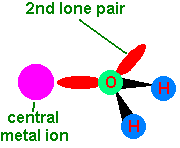
Some ligands only form one dative bond to the central metal ion - they are said to be monodentate. Ammonia, water and the chloride ion are typical examples. Being monodentate doesn't necessarily mean that the ligand only has one lone pair of electrons. Water has two. However, there must be enough flexibility between two lone pairs to allow them both to form a dative bond to the central metal ion. When you consider the geometry involved, when we bond one of the water's lone pairs to the central metal ion, the other one is pointing in the wrong direction. |
|
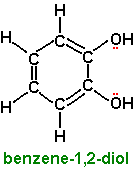
Other ligands are bidentate - that is they can form two dative bonds to the central metal ion. 1,2-diaminoethane and benzene-1,2-diol are examples. Edta is a well-known hexadentate ligand (this forms six dative bonds to the central metal ion). |
|
Read through the theory of stability constants. Then watch the video which shows some ligand exchange reactions taking place. Try to explain any changes you see and then check your answers using the link below. Concentrated hydrochloric acid is a source of the chloride ion ligand.
Video - some copper(II) complex ions