ISSR CLASSES
Checkpoint Science
iGCSE Chemistry
iGCSE Physics
iGCSE Coordinated Science
A-Level Chemistry
PRACTICALS
Practicals Home
Practicals A-Z
Study Plan for Practical Work
The mass spectrum shows the parent ion at m/e 108. This is the relative molecular mass of compound C.
The ir spectrum shows a number of C-H peaks around 3000 cm-1. C-H peaks above 3000 cm-1 suggest an arene. The arene is confirmed by two strong C=C absorptions around 1450 and 1500 cm-1. A strong broad absorption around 3300 cm-1 shows an alcohol O-H group.
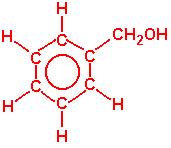
The nmr spectrum confirms an arene with 5 hydrogens around d7.3. The singlet absorption at around d3.2 looks like an alcohol hydrogen (as also indicated in the ir). The 2H is a singlet and looks like a methylene group with a positive carbon atom.
|
We don't need all this analysis to come up with the answer. We know we have an arene with five hydrogen atoms attached (that is, a phenyl group). We also know that we have an alcohol. With a molar mass of 108 there is only one arrangement of these groups - the molecule is phenylmethanol (old name, benzyl alcohol). |
|
We now check that all the facts fit. We might look for some fragments on the mass spectrum. With a phenyl group we expect a strong m/e peak at 77. Loss of the H should give a peak at 107 and loss of OH gives 91. All these peaks are present.
Being a primary alcohol this would change acidified sodium dichromate solution from orange to green on heating.