ISSR CLASSES
Checkpoint Science
iGCSE Chemistry
iGCSE Physics
iGCSE Coordinated Science
A-Level Chemistry
PRACTICALS
Practicals Home
Practicals A-Z
Study Plan for Practical Work
The mass spectrum shows the parent ion at m/e 44. This is the relative molecular mass of compound E. This is a small molecule, so there can't be too many possible structures.
The ir spectrum shows a number of C-H peaks under 3000 cm-1. Checking the data book shows that the pair of absorptions around 2730 and 2850 cm-1 are typical of an aldehyde C-H. There is a clear C=O peak at 1730 cm-1.
The nmr spectrum shows a 1H singlet at d9.8. This confirms the presence of an aldehyde. The 3H singlet at d2.2 could be a methyl group attached to a positive carbonyl carbon atom.
|
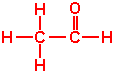
This molecule is fairly small. We now that it has an aldehyde group and four hydrogen atoms. With a mass of 44 there is only one possibility - the molecule is ethanal. |
|
We now check that all the facts fit. We might look for some fragments on the mass spectrum. Losing the aldehyde H would give a fragment at m/e 43. A split to the left of the carbonyl would give a methyl at m/e 15 and a CHO group at m/e 29. All of these fragments are present.
This will give a positive test when warmed with Fehling's solution giving a brick red precipitate.