ISSR CLASSES
Checkpoint Science
iGCSE Chemistry
iGCSE Physics
iGCSE Coordinated Science
A-Level Chemistry
PRACTICALS
Practicals Home
Practicals A-Z
Study Plan for Practical Work
|
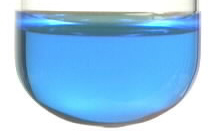
The familiar blue colour of copper(II) sulfate solution is due to the tetraquocopper(II) complex ion, Cu(H2O)42+(aq): |
|
|
|
Concentrated hydrochloric acid contains a high concentration of chloride ions. This ligand replaces the water in the tetraquo complex as the chloro complex has a higher stability constant. The tetrachlorocuprate(II) ion is lime green: |
|
Cu(H2O)42+(aq) +
4Cl-(aq) |
|
On addition to a large volume of water, this ligand replacement reaction is reversed (Le Chatelier's Principle) and we see the original blue colour of the tetraquo complex. However, it is well diluted and can be quite difficult to see (hence the smaller volume of water used in the video). |
|
On addition of ammonia solution to the chloro complex, a further ligand replacement reaction takes place, as the ammonia complex has a higher stability constant than the chloro complex. The tetramminocopper(II) ion is royal blue: |
|
|
CuCl42-(aq) +
4NH3(aq) |
|
You might have heard quite a vigorous reaction in the video when the ammonia was first added. This is due to the exothermic neutralization reaction between the ammonia and the hydrochloric acid. |
|
|
Edta readily replaces water in the aquo complex as the complex ion is particularly stable. The edta complex is sky blue. For the same reason, edta replaces the ammonia in the tetramminocopper(II) complex, and we see a colour change from royal blue to sky blue: |
|
Cu(NH3)42+(aq) +
edta2-(aq) |


 CuCl42-(aq) + 4H2O(l)