ISSR CLASSES
Checkpoint Science
iGCSE Chemistry
iGCSE Physics
iGCSE Coordinated Science
A-Level Chemistry
PRACTICALS
Practicals Home
Practicals A-Z
Study Plan for Practical Work
Density is the mass of a unit volume of a substance. The SI unit of density is the kilogram per cubic metre (kg m-3). This is the mass of a cubic metre of substance. A cubic metre is quite a lot of stuff! A cubic metre of water weighs 1000 kg or 1 metric tonne. It is unlikely that you will be using these quantities in your practical work. Consequently, in chemistry we tend to use grams per cubic centimetre (g cm-3) as our normal unit of density. So using these units, density is simply the mass of a cubic centimetre of substance. It is worth remembering that the density of water at 298 K is exactly 1 g cm-3. Note that the temperature is given. Substances expand (or sometimes contract) as they are heated and this changes the density.
|
|
We usually need to make use of densities so that we can use the volume of a liquid rather than its mass. Measuring mass is generally more accurate than measuring volume, but less convenient. If the quantity of a liquid is not critical (for example, in a preparation), we would find it easier to measure out a volume in a measuring cylinder rather than weigh it on a balance.
|
|
For example, 10 grams of 1-bromobutane (density 1.28 g cm-3) has a volume of 10/1.28 = 7.8 cm3.
|
|
We may need to know the densities of two immiscible liquids so we can work out which is which. The liquid with the lowest density floats on top. You should know that oil floats on water and cream floats on coffee. |
|
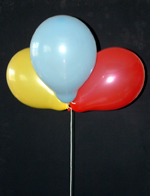
Try to avoid using the term lighter than (or heavier than) when describing densities. This is a common mistake. The statement that helium is lighter than air is quite meaningless as it depends on how much you have. Lighter than means that it has less mass. 1000 grams of helium is clearly not lighter than 10 grams of air. Density considers equal volumes, so the statement that helium is less dense than air does make sense. |
|
The following calculator will work out the volume, given the mass, of a number of substances. Values are given to the nearest 0.1 cm3: