ISSR CLASSES
Checkpoint Science
iGCSE Chemistry
iGCSE Physics
iGCSE Coordinated Science
A-Level Chemistry
PRACTICALS
Practicals Home
Practicals A-Z
Study Plan for Practical Work
Read the following description of a simple calorimetry experiment to measure the enthalpy change for the following reaction:
|
CuSO4(aq) + Zn(s) ⇒ ZnSO4(aq) + Cu(s) |
Make a complete list of errors, work out percentage errors where possible and try to identify the largest error. The key to finding all the errors is to trust nothing! You may want to check the calorimetry theory first.
|
|
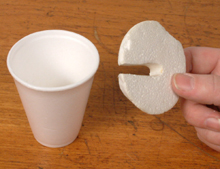
25 cm3 of 0.2 M copper(II) sulfate solution was measured out into a polystyrene cup using a 25 cm3 measuring cylinder. 0.5 g of zinc powder (an excess) was weighed out on a top pan balance which had an accuracy of ± 0.001 g. The starting temperature of the copper(II) sulfate solution was measured using a thermometer which read to the nearest 0.1 ºC. The zinc was added carefully and the mixture stirred well. The blue colour of the copper(II) sulfate faded and the highest temperature reached was recorded. The temperature changed from 23.3 to 31.4 ºC. |
We shall use the following equation to calculate the energy released:
|
Heat (in J) = 4.18 × mass of water (in g) × temperature change (in ºC) |
Temperature change = 31.4 - 23.3 = 8.1 ºC
Heat released = 4.18 × 25 × 8.1 = 846 J = 0.846 kJ
Number of moles of copper(II) sulfate = 0.2 × 25/1000 = 0.005 mol
DH = - 0.846/0.005 = - 169 kJ mol-1.
The accepted value is - 218.7 kJ mol-1.