ISSR CLASSES
Checkpoint Science
iGCSE Chemistry
iGCSE Physics
iGCSE Coordinated Science
A-Level Chemistry
PRACTICALS
Practicals Home
Practicals A-Z
Study Plan for Practical Work
We also use the term thermochemistry. Calorimetry literally means heat measurement. In chemistry, it is usually the measurement of the heat exchanged by a reaction with the atmosphere. You may have met in biology the Bomb calorimeter which measures the heat released on burning foods in a sealed steel container. This energy value is measured at constant volume and is known as an internal energy change.
In chemistry, we are much more interested in the energy exchanged at constant pressure (because this is how most of our reactions are done). This value is known as the enthalpy change.
|
The amount of heat exchanged by a reaction will clearly depend on how much reactant we use. Heat and energy are measured in joules (J), but this is quite a small unit, so we more usually meet kilojoules (1 kJ = 1000 J). We need to choose a convenient amount of reactant to study. As chemists, the mole seems the sensible quantity to choose. So enthalpy change is measured in kJ mol-1 (kilojoules per mole, meaning kilojoules divided by moles). That is the number of kilojoules of heat absorbed or released when 1 mole of reactant reacts. |
|
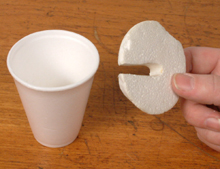
Usually at "A" level we use a fairly simple form of calorimetry involving a plastic cup. Having said that it is simple, we still usually get quite good results. You may meet the more advanced technique of electrical compensation calorimetry.
|
|
In the plastic cup method we mix the reactants together in a polystyrene cup with a lid. We choose the plastic cup as it limits heat loss to (or gain from) the surroundings. At least one of the reactants must be aqueous. The temperature of the reactants before and after reaction is measured. We can then use an equation to calculate the number of joules produced or absorbed by the reaction. You will need to know an equation: |
|
Heat (in J) = 4.18 × volume of solution (in cm3) × temperature change (in ºC) |
There is a bit of cheating going on here, but as mentioned above it does give quite good results. 4.18 (J mol-1 K-1) is the specific heat capacity of water. In other words we are assuming that our solution is pure water. Clearly this is not the case, as it has other chemicals in it. However, it is quite a good approximation as most solutions are largely water, and it is the water which stores most of the heat. We have also used the volume of solution here where it should really be the mass of water (check dimensional analysis). Again, if it is pure water, 1 gram of water has a volume of 1 cm3, so the volume and mass have the same value.
Dividing the number of joules by 1000 gives us the number of kilojoules. We now need to know the number of moles which have reacted. With more than one reactant it is good practice to have all but one in excess. This means that only one of the reactants will completely react. Some of the excess reactants will be left over at the end. We need to decide which reactant is not in excess and work out the number of moles. Dividing kilojoules by number of moles will give us the enthalpy change in kJ mol-1. Don't forget to choose a sensible number of significant figures and to include the sign and units with your answer.
Exercise
25.0 cm3 of 2.00 M sodium hydroxide solution was mixed with 35.0 cm3 of 2.00M hydrochloric acid in an insulated cup. The temperature rose from 18.0 ºC to 29.5 ºC. Given that the specific heat capacity of water is 4.18 g-1 K-1, calculate the enthalpy change for this reaction.
Check your answer here. You can find more calculations here.