ISSR CLASSES
Checkpoint Science
iGCSE Chemistry
iGCSE Physics
iGCSE Coordinated Science
A-Level Chemistry
PRACTICALS
Practicals Home
Practicals A-Z
Study Plan for Practical Work
|
|
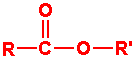
A compound of general formula RCOOR', made by the reaction between an alcohol and a carboxylic acid: |
|
ACID + ALCOHOL |
The reaction is reversible and catalyzed by concentrated sulphuric acid. You can find more details about this reaction here. An alternative, faster reaction produces an ester from an acyl chloride.
|
|
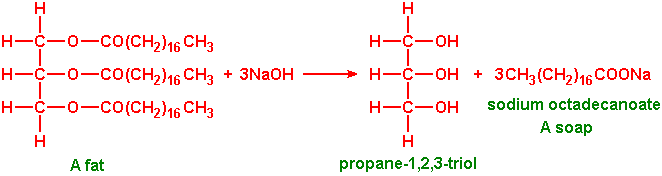
Fats and oils are esters of glycerol (propane-1,2,3-triol) and long chain carboxylic acids which are known as fatty acids. |
You should be aware of the basic rules of nomenclature.
Esters are named in two parts, the first part indicates the parent alcohol, and the second part shows the parent acid. The most common mistake is to get these two parts mixed up. Take a careful look at the formula of your ester. You should see that it does not have a continuous carbon chain, but there are two carbon chains separated by an oxygen atom. The carbon chain which contains the C=O (carbonyl) group has come from the acid. It is named alkanOATE (using the appropriate alkane name). The other carbon chain comes from the alcohol and is named alkYL. The full name is in the form alkyl alkanoate. The examples should make this clear:
Examples
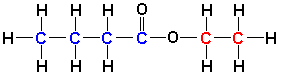
The structural formula is C3H7COOC2H5. Sometimes it causes confusion when it is written as C3H7CO2C2H5 - both are perfectly acceptable.
You should see that the carbon chain with the C=O has four carbons (in blue). This has come from the acid and is called butanoate. The other carbon chain has two carbons (in red). The name is, therefore, ethyl butanoate.
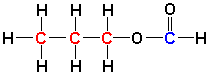
The structural formula is C3H7O2CH
The name is propyl methanoate.
|
|
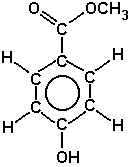
This molecule is a derivative of benzoic acid, C6H5COOH. With a methyl group replacing the COOH hydrogen atom, we would get the ester, methyl benzoate. The molecule shown also has an OH group attached to the benzene ring at position number 4, so this is methyl 4-hydroxybenzoate. |
We saw at the start of this page that esters are made in a reversible reaction from an alcohol and a carboxylic acid. The reverse hydrolysis reaction (also catalyzed by concentrated sulphuric acid) produces the original acid and alcohol:
|
ESTER + WATER |
For example:
|
|
This reaction is also catalyzed by sodium hydroxide solution, but with a slightly different outcome. The sodium hydroxide solution reacts with the acid product to produce the sodium salt of the acid. Consequently, we cannot recover all the sodium hydroxide at the end of the reaction, so technically it's not a catalyst. By removing the carboxylic acid product, this equilibrium is shifted completely to the right by Le Chatelier's principle. You will see in the following that the equilibrium sign has been replaced by an arrow:
|
ESTER + SODIUM HYDROXIDE ⇒ SODIUM SALT + ALCOHOL |
For example:
|
|
|
|
The same type of reaction using sodium hydroxide solution (or occasionally potassium hydroxide solution) is carried out on animal and vegetable oils. It breaks them down into propane-1,2,3-triol (also called glycerol or glycerine) and the sodium salts of fatty acids. These sodium salts are soaps and the process is known as saponification (soap-making). For example: |
|
|

 ESTER +
WATER
ESTER +
WATER