ISSR CLASSES
Checkpoint Science
iGCSE Chemistry
iGCSE Physics
iGCSE Coordinated Science
A-Level Chemistry
PRACTICALS
Practicals Home
Practicals A-Z
Study Plan for Practical Work
You might like to read a brief introduction to organic chemistry first.
|
Nomenclature means naming, and we shall be looking at IUPAC (International Union of Pure and Applied Chemistry) systematic naming which is needed for your exam. Systematic naming gives each molecule a name from which it is possible to work out the structure. This is useful as we can use the structure of the molecule to guess at its properties. However, for complicated molecules the rules for naming become very complex and the name becomes very long. It is quite common at university or in industry to use trivial names. Trivial names usually give little or no detail as to the structure of the molecule, but are generally quite short. Some trivial names are in very common usage and these will be given alongside the systematic names in later text for information. |
|
More rules to learn! They look complicated, but students usually find them quite easy. The rules should make more sense when you see some examples.
You will need to learn the names which follow:
|
1 carbon - methane |
6 carbons - hexane |
|
2 carbons - ethane |
7 carbons - heptane |
|
3 carbons - propane |
8 carbons - octane |
|
4 carbons - butane |
9 carbons - nonane |
|
5 carbons - pentane |
10 carbons - decane |
It may help to make up a mnemonic to remember these. You need a sentence in which the first letter of each word matches up with the first letter of each of the above. My first years have made them up before, but many of them are unprintable!
If the carbon atoms are in a ring the prefix cyclo- is used to give a name like cyclohexane.
These are groups of carbon and hydrogen atoms which are not part of the main chain. They are named in a very similar way:
|
1 carbon - methyl |
6 carbons - hexyl |
|
2 carbons - ethyl |
7 carbons - heptyl |
|
3 carbons - propy |
8 carbons - octyl |
|
4 carbons - butyl |
9 carbons - nonyl |
|
5 carbons - pentyl |
10 carbons - decyl |
The main chain is numbered either from left to right or from right to left depending on which gives the smallest numbers for the attached side chains.
Each group is prefixed by a number to show where it is attached to the main chain. The only punctuation used are commas between two numbers and dashes between a number and a letter. Two of the same side chain are prefixed di (as in dimethyl). You may also meet tri for three groups or tetra for four groups. If there is more than one side chain, they are placed in alphabetical order (ignoring any di, tri, tetra, etc.).
There are occasions where a number is not necessary. For example, in methylpropane. We could call it 2-methylpropane, but the group can only be at position number 2. At positions 1 or 3 we would have a single chain called butane. The same situation can occur when numbering the position of a functional group seen in the next section. You will generally not lose credit if you include a number in these cases, but it isn't really needed.
If there is no functional group then we have an alkane and the name is finished. If there is a functional group in the molecule this has to be identified. We usually use a suffix (ending) to indicate the functional group. If there are two functional groups the second will be identified using a prefix (at the start of the name). You will find the names of the suffixes and prefixes in the table below. Where there is more than one position that the functional group could be in, a number is used to indicate which carbon atom is attached to the functional group. We always number the carbon chain so as to give the smallest number.
Students often get confused with punctuation in the names, but the rules are simple. As with the side chains, the only punctuation used is a comma between two numbers, and a dash between a number and a letter.
Examples
|
|
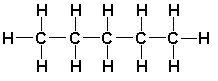
This has no functional groups or side chains. As it has 5 carbon atoms it is known as pentane. |
|
|
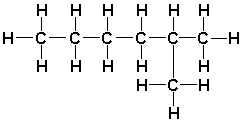
The structural formula is CH3(CH2)3CH(CH3)2 This has no functional groups, but has a methyl group on the second carbon atom (note we count from the end which gives the smallest number). It is called 2-methylhexane. If we used the name 5-methylhexane, it would appear to be a different molecule. However, they are exactly the same - just viewed from opposite sides of the page. |
|
|
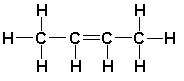
Here we meet the alkene functional group (a carbon-carbon double bond). This is named using the suffix (ending) -ene instead of -ane. This means that you have to be careful with your handwriting as there is little difference between an a and an e. The double bond could be in more than one place in this molecule. It could be between the first and second carbon atoms or between the second and third carbon atoms. A number is required to show its position. We always use the smallest number of the two carbon atoms that the bond joins. The molecule is named but-2-ene. Geometric isomerism is important here. |
|
Also written CH3CH=CHCH3 |
|
|
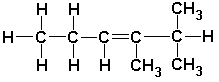
This is 2,3-dimethylhex-3-ene. Check carefully and you will find the longest carbon chain has six carbons in it (the chain bends). There are two methyl groups and one alkene functional group. These have been numbered in order to give the smallest set of numbers. |
For alcohols we remove the "e" from the longest chain name and add the letters "ol". Again di, tri etc are used where there is more than one OH group and numbers are used to locate the groups on the main chain. If there is another functional group name at the end of the name we use the prefix (ie at the start of the name) hydroxy for the OH group.
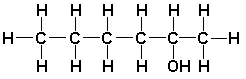 |
This has just one chain of six carbons, which is called hexane. There are no side chains to name or number. The OH group is on carbon number two (note that I have counted from the right to give the smaller number, counting from the left would give five). So this molecule is called hexan-2-ol. Hexan-5-ol does not exist - it is simply hexan-2-ol viewed from the other side of the paper. Note again the clear bond between the C and the O, if this bond points to the H or to the middle of the OH you may not get credit for it in an exam. |
| or CH3CH2CH2CH2CHOHCH3 |
|
|
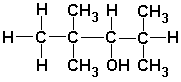
The longest carbon chain here is five and so this is a pentane. Always be careful to spot the longest carbon chain, it isn't always in a straight line. This molecule has three methyl side chains, this time numbered from the left to give the smallest numbers. This is 2,2,4-trimethylpentan-3-ol. Note the use of the punctuation and the use of two 2's to show that two methyl groups are attached to carbon number two. Often people miss the correct length of the carbon chain - it is always the longest carbon chain that is named. |
|
or CH3C(CH3)2CHOHCH(CH3)2. |
Other functional group nomenclature is explained under the appropriate functional group entry. You can head straight to them by using the links below. Alternatively, you might like to try the nomenclature test .
|
Functional group |
suffix |
prefix |
|
-oic anhydride |
||
|
-oyl chloride |
||
|
-ol |
hydroxy- |
|
|
-al |
oxo- |
|
|
-ane |
||
|
-ene |
||
|
-amide |
||
|
-amine |
amino- |
|
|
-oic acid |
carboxy- |
|
|
alkyl alkanoate |
||
|
Halogenoalkane (haloalkane) |
halide |
halo- |
|
-one |
oxo- |
|
|
-ol |
-hydroxy |