ISSR CLASSES
Checkpoint Science
iGCSE Chemistry
iGCSE Physics
iGCSE Coordinated Science
A-Level Chemistry
PRACTICALS
Practicals Home
Practicals A-Z
Study Plan for Practical Work
|
|
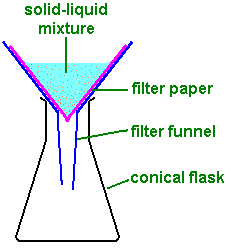
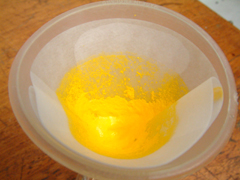
This is the process used to separate an insoluble solid from a liquid. Filter paper allows the filtrate (liquid) to pass through it whilst the solid residue is retained by the paper. Filter paper is available in various grades and sizes. It needs to be folded before it is placed in the filter funnel. The easiest way to fold a filter paper is in quarters. This can then be opened up in the funnel to form a cone. Wetting the paper will keep it in place. |
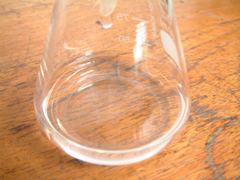
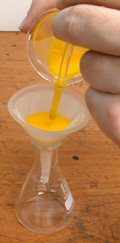
Rest your filter funnel in a conical flask. This is a stable arrangement and much easier than holding your funnel above a beaker. If you must use a beaker to collect the filtrate you will have to use a ring support for the funnel. Don't overfill the filter paper - always keep at least a centimetre from the top. If possible, try to decant (pour off) most of the liquid from the solid residue. This will reduce clogging and speed up the filtration.
 |
 |
|
Sometimes filtration is slow when the particles of solid clog up the pores in the filter paper. Don't be tempted to speed up the process by poking around with a glass rod. The wet filter paper is not very strong, and the glass rod is very likely to tear it. Once torn, both solid and liquid will pass through, and the separation will fail. A more successful method of speeding up the process is to use suction filtration.
Filtration cannot be used to separate two liquids as they would both pass through the paper. This may seem obvious, but it is quite often suggested by students in assessments. To separate two immiscible liquids we use a separating funnel.