ISSR CLASSES
Checkpoint Science
iGCSE Chemistry
iGCSE Physics
iGCSE Coordinated Science
A-Level Chemistry
PRACTICALS
Practicals Home
Practicals A-Z
Study Plan for Practical Work
Solvent extraction
|
|
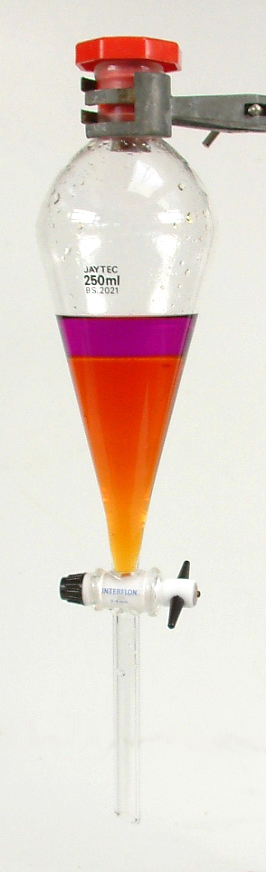
This is a purification process often used to purify organic solids or liquids. Organic products are often much more soluble in organic solvents than they are in water. However, many of the very polar by-products (eg. strong acids, ionic compounds) are much more soluble in water than in organic solvents. The process of solvent extraction uses two immiscible liquids. The product, usually in aqueous solution and mixed with a number of impurities, is shaken vigorously with an immiscible, organic solvent in a separating funnel. The product, being much more soluble in the organic solvent, is largely transferred to the organic layer (that is extracted into the solvent). The aqueous layer retains most of the impurities, so this can be run off and discarded. The product can be obtained from the organic solvent by distilling off the solvent, or just leaving it to evaporate. A common solvent choice is ethoxyethane (ether), (C2H5)2O. This is immiscible with water, is a very good solvent of many organic compounds, and has a low boiling point so can easily be removed from the product afterwards. However, it is highly flammable, and mixtures with air are very explosive, so it tends not to be used in "A" level lab situations. Cyclohexane would be a slightly less hazardous choice. |
Tap is left open before filling. It's fairly obvious what happens!
|
|
Excessive pressure build-up. The funnel is shaken to ensure efficient transfer of the product to the organic layer. During this time the pressure builds up. This may be because the product is being shaken with sodium carbonate solution to remove any acid impurities. This generates carbon dioxide gas that can be seen bubbling away in the funnel. Even if this is not the case, the solvents used tend to be very volatile, and the heat from your hand will cause the pressure to rise rapidly. It is important to release the pressure regularly by opening the tap briefly whilst the funnel is inverted. However, care needs to be taken as any liquid in the neck of the funnel may spray out in the direction of your face! |
Stopper comes off during shaking. Whilst shaking the funnel you must place a finger over the top to ensure the stopper stays in place.
|
Liquid does not run out on opening the tap. After letting the contents settle, it is time to run away the waste portion. If you do not take the stopper off the separating funnel at this stage the air cannot get in and it will be difficult to run off the contents. |
|
Product is thrown away. It is important to throw away the correct portion! If in doubt hang on to both samples. Decide whether you want to keep the aqueous or organic layer. To decide which is which you will have to look up the density of the organic solvent in the data book. Then you can work out whether it floats on top or sinks to the bottom. The liquid with the lowest density will float to the top.