ISSR CLASSES
Checkpoint Science
iGCSE Chemistry
iGCSE Physics
iGCSE Coordinated Science
A-Level Chemistry
PRACTICALS
Practicals Home
Practicals A-Z
Study Plan for Practical Work
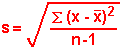
We should always repeat an experiment at least once in order to test the consistency of our results. Ideally we would get the same answer! However, because of the presence of random errors we usually gat a spread of results. A larger spread of answers indicates greater random error, and therefore less confidence in our final results. The spread of a set of results is known as precision. A precise set of results will have a small variation in values. The usual measure of this spread of results is the standard deviation. This can be calculated using the following formula:
|
|
Where s is the standard deviation, S (Greek sigma)
means sum of, x is a particular result,  is the average of all the
results and n is the number of results.
is the average of all the
results and n is the number of results.
|
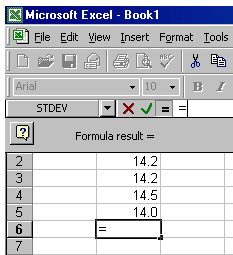
More likely you will calculate the standard deviation using a calculator or spreadsheet. Try to calculate the standard deviation for the four numbers shown on the right either by hand or using a spreadsheet. Also calculate the average. Click on the image to see the answers. There is a 95% probability that any particular result will lie within two standard deviations of the average result. |
|
A high precision (small standard deviation) is a good sign of careful practical work, but it is not necessarily accurate. Accuracy is the closeness to the accepted answer.
To illustrate the concepts of accuracy and precision I'll use an example. I'll take the measurement of the enthalpy of combustion of sucrose (sugar). I decide to burn 10 grams of sugar and measure the enthalpy of combustion. If my balance only reads to the nearest gram this will introduce a significant random error. I could actually be burning anywhere between 9.5 and 10.5 grams. Consequently, I shall get a large spread of results (low precision). The results will vary by at least ± 5% (0.5 in 10) from the average value assuming no other errors. I now invest in a much more accurate balance which reads to the nearest milligram ( ±0.001 g). The random error is much reduced and we get a much tighter set of results (high precision). However, if I have not ensured complete combustion the final answer may still differ significantly from the accepted answer. It may be precise, but it still isn't accurate. Incomplete combustion always gives a smaller numerical answer, it is a systematic error. I cannot get rid of it my doing a lot of experiments and averaging the results. I must improve the experimental technique to get rid of this error.
If two quantities are combined by addition or subtraction we add the absolute errors. For example, we deliver 101 cm3 of solution by using a 100 cm3 pipette followed by a 1 cm3 pipette. The errors from the table are 100 ± 0.16 cm3 and 1 ± 0.012 cm3. If we work these out as percentages we get 100 cm3 ± 0.16 % and 1 cm3 ± 1.2%. If we were to add the percentage errors we would get 101 cm3 ± 1.36% or 101 ± 1.4 cm3. However, this is clearly an overestimate. The first measurement was out by no more than 0.16 cm3 and the second by no more than 0.012 cm3. The total error cannot be more than ± 0.172 cm3, giving a percentage error of 101 cm3 ± 0.17%. The relatively large percentage error for the small measurement is swamped by the more accurate larger measurement.
If two quantities are combined by multiplication or division we add the percentage errors. In calculating the heat evolved by a reaction we use the equation:
|
Heat (in J) = 4.18 × volume of solution (in cm3) × temperature change (in ºC) |
If the volume is 25 cm3 and is measured to an accuracy of ± 0.3 cm3 and the temperature change is 2 ºC ± 0.5 ºC, we get percentage errors of 25 cm3 ± 1.2% and 2 ºC ± 25%. We cannot add the absolute errors as these quantities are multiplied together. The total error is ± 26.2%. To improve the precision of this experiment significantly we must reduce the error for the temperature measurement.
If in doubt always add the percentage errors. This may give you a bigger percentage error than you actually have, but it is better to overestimate your error than underestimate it.