ISSR CLASSES
Checkpoint Science
iGCSE Chemistry
iGCSE Physics
iGCSE Coordinated Science
A-Level Chemistry
PRACTICALS
Practicals Home
Practicals A-Z
Study Plan for Practical Work
Calcium metal is sold in small beads which are not protected by an oil covering used for the Group 1 metals and the more reactive Group 2 metals lower in the group. Consequently, surface oxidation takes place forming calcium oxide. Old samples of calcium can be almost entirely made up of calcium oxide!
Calcium metal reacts quite rapidly with water to form hydrogen gas. Design an experiment to measure the percentage purity of a fresh sample of calcium using a gas volume measurement method. You should indicate appropriate apparatus, method, quantities of reagents and safety considerations.
|
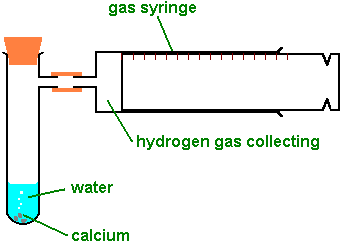
There are alternative methods of measuring gas volume, but a gas syringe attached to a side-arm test tube is probably the most reliable. Sketch and label the apparatus: |
|
We need the correct equation for the reaction. If you're not sure, check the equation in a chemistry text book:
|
Ca(s) + 2H2O(l) ⇒ Ca(OH)2(aq) + H2(g) |
A suitable volume for the 100 cm3 gas syringe is around 60 cm3
60 cm3 of H2 = 60/24000 = 0.0025 mol
From the equation, Ca º H2
So we need 0.0025 mol of Ca
Ca = 40
\ mass of Ca = 40 × 0.0025 = 0.10 g
If it is not pure we would need to use a slightly larger mass of impure calcium to contain around 0.1 g of calcium.
This is a small mass so any reasonable volume of water will be a good excess, say 10 cm3.
Method
Set up the apparatus as above with 10 cm3 of distilled water in the side arm test tube. Weigh accurately about 0.1 g of calcium in a weighing boat. Add the calcium to the water and quickly stopper the boiling tube. Allow the reaction to complete and measure the final volume of hydrogen gas in the gas syringe.
Safety
Calcium is a flammable, reactive metal and should not be handled directly. The calcium hydroxide formed is alkaline and, therefore, corrosive. Eye protection should be worn and any spills washed off immediately with water. The glassware will contain a hydrogen/air mixture. This is potentially explosive. There should be no naked flames nearby.
Analysis and evaluation exercise
When the experiment was carried out 0.126 grams of calcium metal produced 72.0 cm3 of gas. Calculate the percentage purity of the calcium sample. Carry out an error analysis and suggest any improvements. What additional problems might occur if a similar experiment were attempted with sodium metal?