ISSR CLASSES
Checkpoint Science
iGCSE Chemistry
iGCSE Physics
iGCSE Coordinated Science
A-Level Chemistry
PRACTICALS
Practicals Home
Practicals A-Z
Study Plan for Practical Work
|
|
Isomers are molecules with the same molecular formula (that is, they contain the same number and type of atoms), but with a different arrangement of the atoms. In structural isomerism, the structural formula is different. This means that the atoms are attached in a different order. Ethanol (CH3CH2OH) and ethoxyethane (CH3OCH3) are structural isomers. So are 1-chloropropane (CH3CH2CH2Cl) and 2-chloropropane (CH3CHClCH3). |
|
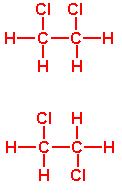
In the above examples we can clearly see the different arrangement of the atoms. Sometimes students find isomers where there is none. This is usually because of the way we represent the molecules as two-dimensional on paper. It helps here to make your molecule with molecular models. The two molecules on the right look different. In one the chlorine atoms are next to each other and in the other they are further apart. However, it is possible to rotate a single bond (try it with your model), so it is easy to convert one into the other. In the actual molecule the bond rotates rapidly so the two apparently different molecules are indistinguishable. |
|
|
|
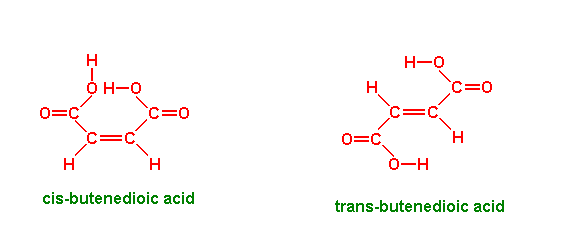
A different situation occurs with a double bond present as rotation is not possible about a double bond. Try to rotate the double bond in your model. This means that the two molecules shown on the left here are geometric isomers. Although the structural formula is the same in both cases (CH3CH=CHCH3), it is possible for the two isomers to have very different physical and chemical properties. The molecule with the two large groups on the same side of the double bond is called cis-, and if these two groups are across the double bond it is called trans-. |
A good example of geometric isomerism is seen with butenedioic acid. Cis-butenedioic acid is known as maleic acid and trans-butenedioic acid is called fumaric acid. The different names come from before the structures were known, and show that they behave differently. One of these molecules can lose a water molecule to become an anhydride. Try to decide which and click here to find out which it is. One of the isomers has a much higher boiling point than the other as a result of hydrogen bonding. Try to decide which this is and check your answer by clicking here .
The simple cis-trans naming system breaks down when there are three or more different groups attached to the two carbons of the double bond. This is where the E-Z system is helpful. We first work out a priority for each of the groups attached to the double bond carbon atoms. The atom with the highest atomic number has the highest priority. If the atoms have the same atomic number we move further down the chain and continue to use the highest atomic number to find the highest priority.
If the two groups with the highest priorities are on the same side of the double bond it is labelled Z (from the German zusammen, together). If the two groups with the highest priorities are on opposite sides of the double bond it is labelled E (from the German entgegen, opposite). An example should make this clearer:
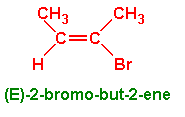 |
On the left hand double bond carbon the methyl group has a higher priority than the H (atomic number for C = 6, but for H = 1). On the right hand double bond carbon the Br has the higher priority ( atomic number for Br = 35, but for C = 6). As the two highest priority groups are on opposite sides of the double bond it is labelled (E). |