ISSR CLASSES
Checkpoint Science
iGCSE Chemistry
iGCSE Physics
iGCSE Coordinated Science
A-Level Chemistry
PRACTICALS
Practicals Home
Practicals A-Z
Study Plan for Practical Work
The weighings are accurate to ± 0.001 g. However, as the mass of magnesium (and of oxygen) are calculated from two weighings (before and after), the total error is twice this, that is ± 0.002 g.
We can calculate percentage errors. For the magnesium, ± 0.002/0.499 × 100 = ± 0.4%
For the oxygen, ± 0.002/0.195 × 100 = ± 1.0%
This gives a total error of ± 1.4%. This is only a small part of the 7% deviation from the correct answer. It helps to try this experiment several times. Each time we find the oxygen value is low compared to the magnesium value. This suggests that there is some systematic error, or errors, which consistently lead to a high magnesium value or a low oxygen value. It can't be a high magnesium value. All we did was to put the magnesium in the crucible and weigh it. There couldn't be more magnesium than the total mass weighed. This means that some systematic error, or errors, are leading to a low oxygen value. There are several possible explanations. Having located them we could try to reduce them in a future experiment.
|
|
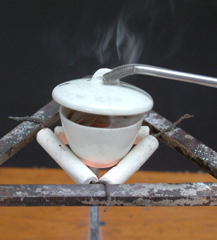
There is a clue to the first error in the picture. We can see some magnesium oxide smoke escaping when the lid is lifted. This would mean that the final mass is smaller than it should be. This would lead us to calculate a smaller mass for the oxygen. |
|
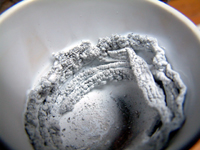
The second problem is incomplete reaction. If not all of the magnesium reacts with oxygen, we shall not be measuring the total possible mass of oxygen combined. We shall get a smaller value again. It's quite easy not to get complete reaction as the oxygen supply is limited. Air gets in when the lid is lifted, but the relatively slow reaction may allow some bits of magnesium to become coated in the oxide. This may protect them from further reaction with oxygen. |
|
We are assuming that the original metal was 100% magnesium. Any impurities which do not react with oxygen, or any surface oxide which was not removed, will reduce the amount of oxygen reacting with our metal.
Finally, a not so obvious error. Magnesium can also react with nitrogen to form a nitride. Work out the formula of the nitride, and hence calculate whether this error would lead to a smaller amount or greater amount of oxygen being measured. You can check your answer here .