ISSR CLASSES
Checkpoint Science
iGCSE Chemistry
iGCSE Physics
iGCSE Coordinated Science
A-Level Chemistry
PRACTICALS
Practicals Home
Practicals A-Z
Study Plan for Practical Work
|
Organic chemistry is the chemistry of carbon compounds. It is an important branch of chemistry because there are so many carbon compounds, and because plants and animals (us!) are based on carbon chemistry. The atoms in organic molecules are held together by covalent bonding. |
|
We represent the bonds which hold the atoms together by lines. An atom may be joined by a single bond (a single line), a double bond (a double line) or a triple bond (a triple line). It is important that each type of atom has the correct number of bonds joining it to its neighbour(s) - these numbers need learning. If the atom is uncharged:
|
Carbon always has 4 bonds |
Rest of group 4 has 4 or more bonds |
|
Nitrogen always has 3 bonds |
Rest of group 5 has 3 or more bonds |
|
Oxygen always has 2 bonds |
Rest of group 6 has 2 or more bonds |
|
Fluorine always has 1 bond |
Rest of group 7 has 1 or more bonds |
|
Hydrogen always has 1 bond |
|
In most cases the atoms will be uncharged and these will be the correct number of bonds - if your molecule has a different number then it is wrong! You will meet a few molecules/ions with charged atoms where these numbers will vary.
There are a number of ways of representing an organic molecule, I shall use butan-1-ol to demonstrate them. The molecular formula simply shows the number of each type of atom in one molecule of the compound. In the case of butan-1-ol it is C4H10O.
However, it is possible to arrange these atoms in a number of different ways which all have the correct number of bonds shown above. The structural formula gives details on how the atoms are attached. The structural formula for butan-1-ol is CH3CH2CH2CH2OH. Molecules with the same molecular formula but a different structural formula are called structural isomers.
|
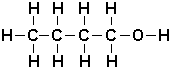
The most detailed representation is the displayed formula - this shows all the atoms and the bonds which attach them: |
|
Be careful how you draw the displayed formula - all bonds should be shown accurately. The most common exam error here is to leave out the bond between the O and the H, that is write it as OH. This may lose the mark. If you draw a bond which points vaguely between two atoms the examiner will not be conned! Try to draw the isomers (different arrangements of the atoms) for C4H10O - I can think of six others. You can find the answers here.
Given that there are millions of organic compounds we need to find some method of rationalizing them so that we can compare molecules and guess the properties of new molecules which we have not met. We find that the carbon and hydrogen atoms which make up the skeleton of the molecule are rarely involved in chemical reactions. It is the other atoms in the molecule or double and triple bonds which tend to react, and we call these parts functional groups. Molecules with the same functional group tend to have very similar chemical properties (reactions with other molecules/atoms), and are said to belong to a homologous series. The different carbon skeletons in different molecules will amend the properties slightly and will give the molecule different physical properties (like density and melting point). You can find all the functional groups we meet at "A" level in the organic nomenclature section.