ISSR CLASSES
Checkpoint Science
iGCSE Chemistry
iGCSE Physics
iGCSE Coordinated Science
A-Level Chemistry
PRACTICALS
Practicals Home
Practicals A-Z
Study Plan for Practical Work
Permanent dipoles
|
|
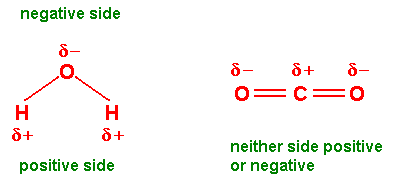
A polar molecule is said to contain a permanent dipole (that is a positive and negative end). A covalent bond will be polar (that is have a positive and negative end) if there is a difference in electronegativity between the two atoms which make it up. However, it does not necessarily follow that just because a molecule contains polar bonds that the molecule itself will be polar. It may be that the various polar groups in the molecule will cancel out leaving no overall dipole. Though clearly, if none of the bonds in a molecule is polar, the molecule overall must be non-polar. This is illustrated by the examples of carbon dioxide and water. Both of these molecules contain polar bonds, but because of their shapes, water is polar and carbon dioxide is not: |
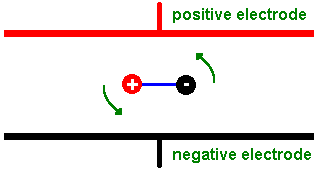
We measure the degree of permanent dipole a molecule contains by its dipole moment, which is measured in units called Debyes (D). You can find various dipole moment values in a data book or in the dipole moment table. The dipole moment of a molecule is a measure of the turning force that acts on it in an electric field:
Molecules that contain a permanent dipole tend to have higher melting and boiling points than similar non-polar molecules. This is because the positive end in one molecule will attract the negative end in an adjacent molecule. You are often asked to draw diagrams of this interaction in the exam. For example, in the molecule, methanal: