ISSR CLASSES
Checkpoint Science
iGCSE Chemistry
iGCSE Physics
iGCSE Coordinated Science
A-Level Chemistry
PRACTICALS
Practicals Home
Practicals A-Z
Study Plan for Practical Work
Electronegativity
|
Electronegativity is a measure of the strength of attraction an atom has for the pair of electrons in a covalent bond. |
|
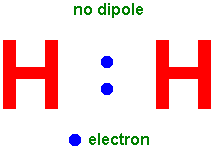
It enables us to work out whether a covalent bond will be polar, and if so, which atom is positive and which atom is negative. Where the same atoms are bonded together (for example in the hydrogen molecule, H-H) each atom has the same pull on the bond pair of electrons. Consequently, they are shared equally and this molecule will be non-polar. |
|
|
|
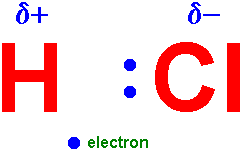
However, in most bonds with different atoms attached, one atom has a greater pull on the electrons than the other - it is said to be more electronegative. This means it will have a greater share of the bonding electrons, and consequently it has a small negative charge. This is labelled d- (d is the Greek small delta, so this is pronounced delta minus). The other atom will have a small positive charge, labelled d+. This means that the bond has a plus end and a minus end - it is said to be polar, or possess a dipole. |
|
This polarity is important to know about in organic chemistry, as it gives us clues as to which atoms in one molecule will attract which atoms in another molecule (plus attracts minus). Once attracted, these atoms often become bonded. Groups attracted to a positive atom are called nucleophiles, and groups attracted to negative atoms are called electrophiles.
We use the Pauling scale of electronegativity that can be found on page 49 of the Nuffield data book. Using this we can predict the dipoles in the following bonds. Make your prediction and click on the bond to check your answer:
 |
 |
 |
 |
 |
 |
 |
 |