ISSR CLASSES
Checkpoint Science
iGCSE Chemistry
iGCSE Physics
iGCSE Coordinated Science
A-Level Chemistry
PRACTICALS
Practicals Home
Practicals A-Z
Study Plan for Practical Work
|
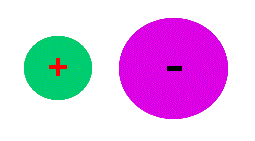
Our model of ionic bonding is that the charged ions which make up the compound are perfect spheres: |
|
|
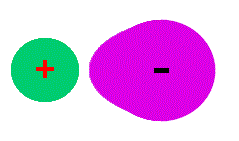
The reality is slightly different! The negative anion has an extra electron(s) in its outer shell and this cloud of electrons is quite easily distorted. In particular, it will be attracted towards the adjacent positive cation. This results in the anion not being a perfect sphere, but taking on more of a pear shape: |
|
This effect will be greater if the cation has a larger charge, or is smaller so that its positive centre can get closer to the anion. This polarizing effect can have an effect on the stability of the anion. It encourages the decomposition of the carbonate ion, CO32-, into carbon dioxide gas, CO2, and the oxide ion, O2-. Consequently, we see that the group 1 carbonates do not decompose on heating as the cation has only a 1+ charge. There is an exception to this - lithium carbonate does decompose, but then it has the smallest cation. Group 2 carbonates with the 2+ cation all decompose on heating, although decomposition gets more difficult down the group as the cations get larger.