ISSR CLASSES
Checkpoint Science
iGCSE Chemistry
iGCSE Physics
iGCSE Coordinated Science
A-Level Chemistry
PRACTICALS
Practicals Home
Practicals A-Z
Study Plan for Practical Work
In the first three of the following reactions try to suggest an equation and decide whether the process involves addition polymerization or condensation polymerization. Check your answers in the link below.
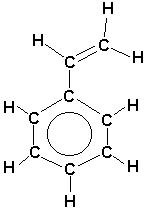
1 Preparation of poly(phenylethene)
|
The polymerization process occurs readily on the addition of a free radical initiator, like potassium peroxodisulfate. You should see from the video that the lengthening polymer chains have a significant effect on the properties of the liquid. The old name for phenylethene is styrene, and so the polymer is also known as polystyrene. |
|
|
phenylethene |
2 The "nylon rope trick"
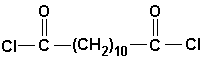
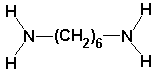
There are a number of different nylon polymers. In this experiment we make nylon 10:6 by the reaction between decanedioyl dichloride (formerly known as sebacoyl chloride) and 1,6-diaminohexane:
|
|
|
|
decanedioyl dichloride |
1,6-diaminohexane |
The two reactants are dissolved in different solvents - one aqueous and one hydrocarbon. The liquids are then carefully added together ensuring they do not mix, but form separate layers. The nylon forms at the interface between the two liquids, and can be pulled out using forceps. The idea behind the nylon rope trick is that the nylon is placed over a couple of glass rods, and under its own weight continues to pull out of the beaker of reactants. In this way a long length of nylon rope automatically forms and falls to the floor. However, whilst I have seen it done, I have never been successful myself. The video is no exception! Even with two metres length of rope hanging down, the friction between glass and nylon continued to support the weight. This despite desperate attempts at lubrication with washing-up liquid and graphite. Perhaps you will be more successful!
Video - the "nylon rope trick"
|
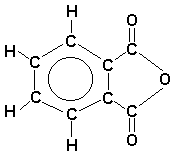
3 The preparation of a polyester resin The reactants in this polymerization are benzene 1,2-dicarboxylic anhydride and propane-1,2,3-triol. The anhydride is made by the loss of a water molecule from benzene-1,2-dicarboxylic acid. The three alcohol groups in the propane-1,2,3-triol allow extensive cross-linking, making this polymer rigid. Suggest a possible equation for the reaction between two molecules of propane-1,2,3-triol and one of benzene 1,2-dicarboxylic anhydride. What type of polymer is this one? Video - the preparation of a polyester resin You will have noticed the steady increase in viscosity as the reaction proceeds and the polymer chains lengthen. |
|
|
benzene-1,2-dicarboxylic anhydride |
|
|
|
|
|
propane-1,2,3-triol |
4 The preparation of a cross-linked polymer
Polyethenol is made from ethenol, CH2=CHOH. This has the old name vinyl alcohol, and the polymer is known as poly vinyl alcohol or PVA. PVA is used in certain glues and for sealing porous walls prior to plastering. The borate ions cross-link the poly(ethenol) molecules making the mixture much more viscous. However, the hydrogen bonds involved are relatively easily broken so the mixture is not rigid like the last polymer. You will find an equation showing this cross-linking on page 442 of the Students' text book.
Video - the preparation of "slime"