ISSR CLASSES
Checkpoint Science
iGCSE Chemistry
iGCSE Physics
iGCSE Coordinated Science
A-Level Chemistry
PRACTICALS
Practicals Home
Practicals A-Z
Study Plan for Practical Work
Precipitation is the process where a solid is formed from a solution. When two salt solutions are mixed, new salt combinations become possible. If one of these salts is insoluble, then it will precipitate from the solution. Solubility is very important in order to understand precipitation, so make sure that you understand the solubility table.
For example, if we mix together potassium iodide solution and lead(II) nitrate solution, a precipitate of lead(II) iodide forms. Whilst the original salts were soluble, when they were mixed two new salt combinations became possible - lead(II) iodide and potassium nitrate. Whilst potassium nitrate is still soluble, lead(II) iodide is not, so it precipitates from the solution:
Video - precipitation of lead(II) iodide
You will see the production of the bright yellow salt, lead(II) iodide. The dense solid settles fairly quickly to the bottom of the beaker. Less dense precipitates may take some time to settle and this often causes students to miss that a precipitate has formed. You should also understand why lead salts can be used as paint pigments. Lead(II) iodide is an interesting material - the bright yellow solid dissolves in hot water to give a colourless solution!
When writing equations for precipitation reactions it is important to include the state symbols. The key to spotting a precipitation reaction is the presence of a solid product. For the above reaction:
|
Pb(NO3)2(aq) + 2KI(aq) ⇒ PbI2(s) + 2KNO3(aq) |
All that has happened in this reaction is that the lead(II) ions have met up with the iodide ions to form the solid precipitate of lead(II) iodide. This then sank to the bottom of the solution. The potassium and nitrate ions were in solution at the start, and are in solution at the end - they have done nothing. They are called spectator ions and you are often asked to leave them out of the equation to give an ionic equation. The ionic equation contains ions (surprise!), but only those which are involved in the reaction. For the above reaction the ionic equation is:
|
Pb2+(aq) + 2NO3-(aq)+ 2K+(aq) + 2I-(aq) ⇒ PbI2(s) + 2K+(aq)+ 2I-(aq) |
|
Pb2+(aq) + 2I-(aq) ⇒ PbI2(s) |
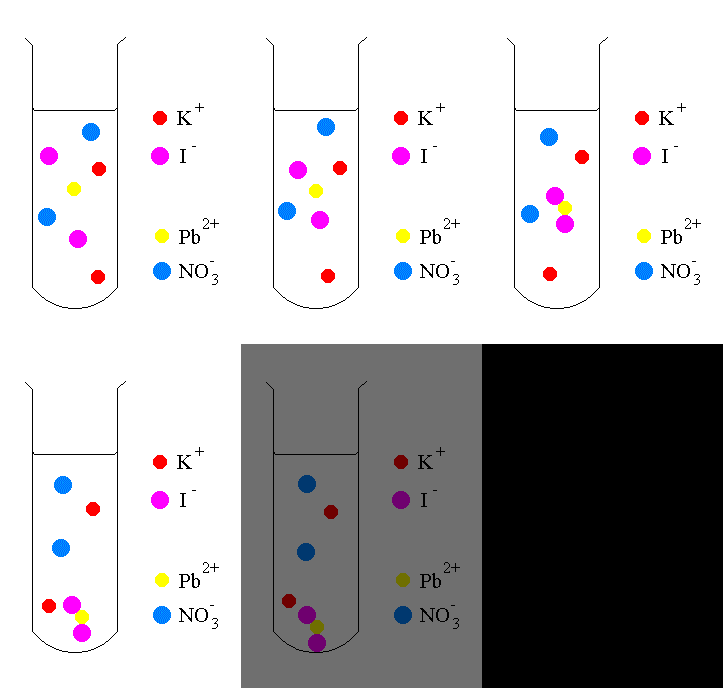
The following animation represents this precipitation process. You should see that the spectator ions jiggle about randomly during the process. The only real change which occurs is the coming together of the Pb2+ and I- ions:
Animation - the precipitation of lead(II) iodide
|
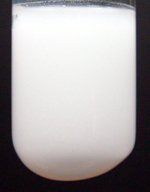
Mistakes are often made with observations of precipitates, particularly with the many white precipitates which are produced. Students often describe the formation of a white precipitate as "solution went white", but miss out the important state change (the precipitate). A fine precipitate may take some time to settle so that it is not obvious a solid has been made. Try to look on the surface of the glass for the solid. Also, bear in mind that if you can't see through the solution, it's not a solution! |
|