ISSR CLASSES
Checkpoint Science
iGCSE Chemistry
iGCSE Physics
iGCSE Coordinated Science
A-Level Chemistry
PRACTICALS
Practicals Home
Practicals A-Z
Study Plan for Practical Work
In order to understand why acids vary in strength we must first understand what an acid is. An acid is a proton (H+) donor. So it follows that an acid must contain some hydrogen. However, just because a molecule contains a hydrogen atom it does not follow that it will be an acid. The hydrogen atom must be able to be released easily from the rest of the molecule by heterolytic fission forming a free ion.
|
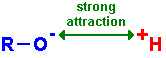
In many cases the loss of the positive hydrogen ion is prevented because the negative charge left behind is localized on the other atom. This attracts back the hydrogen ion and prevents its escape. This is the case in the alcohols, which are consequently not acidic: |
|
|
|
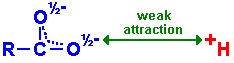
However, in the case of the carboxylic acids the delocalisation of the negative charge in the oxy-anion means that there is effectively only a half charge on each oxygen atom. This makes it much easier for the hydrogen ion to escape, and consequently these molecules are weakly acidic. |
|
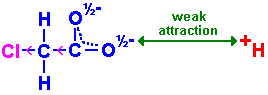
Any groups attached to an acid molecule which further attract electrons from the negative ion, formed on losing the hydrogen ion, will further reduce the negative charge where the hydrogen ion is escaping from. This makes the process easier and the molecule more acidic. Halogen atoms are very electronegative, and are therefore good at increasing the acidity of the molecule. Consequently, chloroethanoic acid is a stronger acid than ethanoic acid. |
|
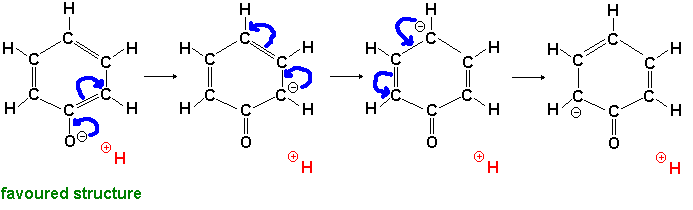
The negative charge on the phenoxide ion (formed by lose of a hydrogen ion from phenol) can be delocalised in the benzene ring. However, phenol is a much weaker acid than the weak carboxylic acids seen above. This often confuses students as there appears to be much more space to spread out the negative charge in the phenol. The big difference is where the negative charge resides in these molecules. In the case of the carboxylic acids, moving the electron pairs results in two identical structures with the negative charge on an oxygen atom. The real structure is in between these two possible arrangements. As the two structures are identical, neither is favoured, and the real structure is exactly in between the two. This means that in the real structure the negative charge is split evenly between the two oxygens with a half minus charge on each atom (as in the diagram above).
The case of the phenoxide ion is more complicated. By moving the negative charge off the oxygen atom we have to place it on a carbon atom in the benzene ring (there is a choice of three). However, this structure is not the same as that with the negative charge on the oxygen. The oxygen atom is much better at attracting negative charges than the carbon atom (it is more electronegative). Consequently, the real structure is closer to that with the negative charge on the oxygen - the charge is not shared equally on all the atoms. With a larger negative charge on the oxygen it is more difficult for the hydrogen ion to escape, and so phenol is a much weaker acid than the carboxylic acids.