ISSR CLASSES
Checkpoint Science
iGCSE Chemistry
iGCSE Physics
iGCSE Coordinated Science
A-Level Chemistry
PRACTICALS
Practicals Home
Practicals A-Z
Study Plan for Practical Work
|
|
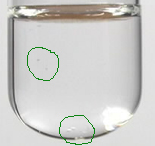
Ammonia is extremely soluble in water. Smaller amines also readily dissolve as they possess a hydrophilic amine group which can hydrogen bond to water molecules. However, the hydrocarbon chain is hydrophobic, and as this gets larger the solubility of the molecule decreases. Consequently, the butylamine, with the relatively small butyl group, dissolved in hot and cold water, but the much larger ethyl 4-aminobenzoate showed much reduced solubility. There was little sign of solubility in the cold water, and even in the boiling water we saw the solid melt but it did not all dissolve. If you look carefully at the photograph on the left you will see oily drops of liquid ethyl 4-aminobenzoate in the final solution. |
The amines are alkaline as the equilibria set up when they are added to water produce hydroxide ions:
|
NH3(aq) + H2O(l) |
and
|
C4H9NH2(aq) +
H2O(l) |
The ion in this second equilibrium is known as the butylammonium ion. Be careful here - because it is called butylammonium, students are often tempted to write it as C4H9NH4+. However, the amine only has one lone pair, and can only pick up one extra hydrogen. It is simply an ammonium ion in which one of the hydrogen atoms has been replaced by the butyl group.
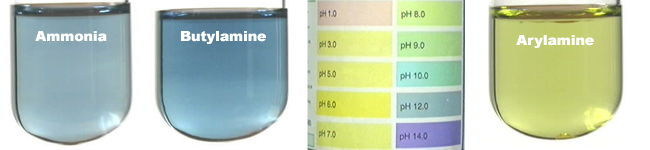
Estimating the pHs from the above photograph, we find the ammonia solution has a pH just under 12, the butylamine is just over 12 and the ethyl 4-aminobenzoate (the arylamine) is around pH 9.
The amines are all bases, as the lone pair on the nitrogen atom of the NH2 group can pick up a proton by forming a dative bond. Arylamines are weaker bases than ammonia, as their lone pair is partly delocalised in the benzene ring, and so less available to attract protons. Alkylamines (like butylamine) are stronger bases than ammonia, as there is a higher electron density on the nitrogen atom. This is because the alkyl group is electron releasing.
 NH4+(aq) + OH