ISSR CLASSES
Checkpoint Science
iGCSE Chemistry
iGCSE Physics
iGCSE Coordinated Science
A-Level Chemistry
PRACTICALS
Practicals Home
Practicals A-Z
Study Plan for Practical Work
|
|
|
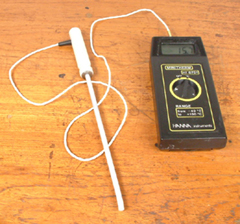
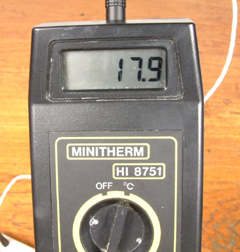
A thermometer is an instrument for measuring temperature. There are many different types that vary in range and accuracy. The most common type met in schools and colleges is the liquid-in-glass type. These are glass tubes containing a liquid (coloured alcohol or mercury are most likely to be used). As the liquid heats up, it expands and rises up the tube. The glass tube has a scale marked on it, from which the temperature can be read. If you are choosing a thermometer it is important to state the range (ie between which temperatures it can measure) and the accuracy (how closely can it be read). Two popular liquid-in-glass thermometers are shown in the photograph. There is a - 10 to 110 °C ± 0.5 °C alcohol thermometer and a - 10 to 360 °C ± 0.5 °C mercury thermometer. The small red triangular plastic pieces that you can see in the photographs prevent the thermometers from rolling of the bench. Digital thermometers are becoming more popular. They are more expensive than most liquid-in-glass thermometers, but are generally more accurate and less easy to break. The probe contains a device for measuring the temperature called a thermocouple and the box contains the electronics for converting the probe's electrical signal into a temperature. They are available in a number of ranges and accuracies. The one shown is typical of schools and colleges and has a range of - 40°C to + 150°C and an accuracy of ± 0.1°C. Some digital thermometers can be unreliable and suffer from drifting. |
|
|
|
The measurement of temperature leads to experimental error. You can find out more about this in the error handling section.
Don't contaminate solutions with a dirty thermometer. If you are using the same thermometer to measure the temperature of two different solutions, make sure you rinse and dry the thermometer between measurements. If you use different thermometers to measure the two temperatures, bear in mind they may not be reading the same temperatures (see the photograph above!).