ISSR CLASSES
Checkpoint Science
iGCSE Chemistry
iGCSE Physics
iGCSE Coordinated Science
A-Level Chemistry
PRACTICALS
Practicals Home
Practicals A-Z
Study Plan for Practical Work
|
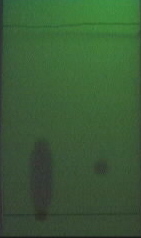
The principle behind this technique is the same as that for paper chromatography. However, rather than using paper as the stationary phase, a thin layer of absorbent material is applied to a glass or plastic sheet. This is called a plate. These can be made in the laboratory, but are more commonly bought ready made. If we have been successful in purifying our product, a single spot will be seen. Impurities show up as additional spots or a spread. This relies on the products and impurities being visible - colourless materials are not easy to see! A number of techniques can be used to develop invisible spots. The use of ultra-violet light (as seen in the photograph) and iodine vapour (which stains the spots) are two common methods. |
|
|
a tlc plate seen |
We see in the video how to make some fine glass droppers. Students are quite keen on this activity, but can take some time to get it right. If the glass tube is placed too low in the Bunsen flame it will not melt in the inner blue cone, and two narrowings are produced. You have to be quite quick to pull the tube when it comes out of the flame, otherwise it will harden again and not extend. Don't be too keen to pull the melted tube apart. You can get some very fine tubing, but it doesn't work well as a dropper. Finally, if you pull the tube within the flame it will separate and seal both ends.