ISSR CLASSES
Checkpoint Science
iGCSE Chemistry
iGCSE Physics
iGCSE Coordinated Science
A-Level Chemistry
PRACTICALS
Practicals Home
Practicals A-Z
Study Plan for Practical Work
The alkanes are saturated hydrocarbons. That is they are composed only of carbon and hydrogen atoms held together by single bonds.
Crude oil is largely a complex mixture of alkanes, and it is from this source that most of the alkanes are obtained. The first four alkanes, methane to butane, are gases at room temperature. The next few are liquids and the larger ones are solids. They are non-polar molecules and consequently they are immiscible with water. Their old name is the paraffins which means unreactive. This may seem odd when they can react explosively with air, but they have very few other reactions as they contain only the relatively unreactive C-C and C-H bonds. This has its uses - polythene is a very large alkane which has the useful property that it resists attack by most chemicals.
|
|
The main use of the alkanes is as fuels. Methane is the main constituent of natural gas which is used for domestic heating and cooking. Butane is used in gas lighters and octane is a major constituent of petrol. |
Alkanes contain no functional groups. When we name any molecule we always start by naming the alkane skeleton. You can see how to do this using the organic nomenclature section.
Examples
|
|
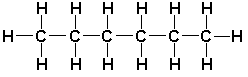
This alkane has no side chains. With six carbon atoms in the chain, it is called hexane. |
|
|
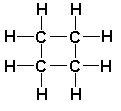
Alkanes which are in a ring are given the prefix cyclo-. With four carbons in the ring this molecule is called cylcobutane. |
|
|
With seven carbon atoms in the longest chain this molecule has heptane in the name. It has a methyl group on the third carbon atom (remembering to count from the end which gives the smallest number). This is 3-methylheptane. |
|
|
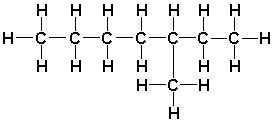
Here's a challenge which uses most of the rules! Be careful to find the longest carbon chain - there are eight carbon atoms here. There are three side chains - two methyl groups and one ethyl group. Using the alphabet rule gives us the name 4-ethyl-3,6-dimethyloctane. If you point at the molecule things may become clearer! |
The main feature of the alkanes is their lack of reactivity, so don't be too surprised if not much happens in the following experiments.
1 Combustion
Alkanes generally burn with a clean, blue flame. Write a balanced equation for the complete combustion of hexane.
2 Action of bromine
Bromine water is used as a test for alkenes, where it is readily decolorized. Alkanes have no immediate effect on shaking with bromine water.
3 Action of bromine in sunlight
The use of bromine in an inert solvent (rather than the usual bromine water) allows it to mix with the non-polar hexane. The reaction is attempted in sunlight and in the dark. Any fumes which were evolved were tested with ammonia gas. Deduce the products of any reaction, and write a balanced equation for it.
Video - the reaction of hexane with bromine in sunlight
4 Catalytic cracking
We have used liquid paraffin as the alkane and an aluminium oxide catalyst. Liquid paraffin is a mixture of alkanes containing around ten to twelve carbon atoms. The gases that are produced are collected over water, remembering that the first few bubbles will be air. We test the collected gases with bromine water. From your observations try to identify a product of this reaction, and then suggest a balanced equation for the reaction with decane, C10H22. Strong heating is needed, so care needs to be taken to avoid suck back.
Reactions of the alkanes - results and equations