ISSR CLASSES
Checkpoint Science
iGCSE Chemistry
iGCSE Physics
iGCSE Coordinated Science
A-Level Chemistry
PRACTICALS
Practicals Home
Practicals A-Z
Study Plan for Practical Work
This piece of apparatus is used to measure out accurately different volumes of liquids. It is most likely to be met in a titration. The most common size of burette is 50 cm3. It should be accurate to at least the nearest 0.1 cm3. Always read and record your results to the nearest 0.05 cm3 (about 1 drop).
|
|
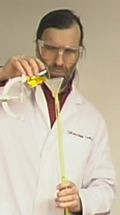
The burette must be cleaned out before use. It needs to be washed using the solution that it is to contain. Do not use water for the cleaning as this will leave some water in the burette and reduce the concentration of the solution to be used. Add about 10 to 20 cm3 of solution to the burette after having checked that the tap is closed. Place the burette over the sink or a waste beaker and open the tap in order to clean out the jet. Close the tap and hold the burette almost horizontal with the open end over the sink. Rotate it so that all the surfaces are cleaned and the solution empties out of the top of the burette. Open the tap fully to clear out the jet. Close the tap and use a funnel to fill the burette with solution, take care not to overfill it. Remove the funnel. Again place the burette over the sink or waste beaker and open the tap fully in order to fill the jet. Always check to see that there is no air bubble in the jet. Clamp your burette and ensure it is vertical. |
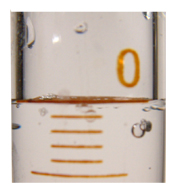
You do not need to fill your burette to the zero mark every time. In fact, it is good practice to start your titrations at different points on the burette. This allows for any inconsistencies in the burette (though make sure there's enough solution for your titration!). The volume is always read to the bottom of the meniscus. Make a note of the starting volume. A piece of white paper placed behind the scale will make it easier to read. After the volume of solution has been delivered, make a note of the final volume. A simple subtraction of the start volume from the final volume gives the volume used.
After use, rinse the burette out thoroughly with distilled water. It can then be clamped upside down in its stand, with the tap open so that it can drain.
|
A dirty burette will have a poor meniscus, making it difficult to read the volume. The only way to deal with this is to clean the burette thoroughly by soaking it in a suitable laboratory cleaning solution. However, for the accuracy required at "A" level, a reasonable estimate of the position of a poor meniscus does not usually introduce too large an error. |
|
Incorrect cleaning. The burette should be cleaned out with the solution that it is going to contain.
|
|
Hazardous filling. This is seen when the burette is filled above head height. Use a funnel and hold the burette below bench level so that it can be filled safely at or below head height. Make sure the tap is off when filling. |
Overfilling. The funnel holds quite a volume of liquid. If the funnel is still full when the burette is nearly full, the excess liquid will overflow and pour down the outside of the burette. It often happens, and tends to be embarrassing!
Use of dirty burette. This gives poor and inconsistent readings. The signs of a dirty burette are a flat meniscus and poor draining with solution droplets clinging to the side of the glass. These droplets should have been delivered from the burette. The easiest solution is to get another (clean!) burette.
Air bubble in jet. This may well fill during the titration and increase the reading on the burette. Open the tap fully to clear the air bubble.
|
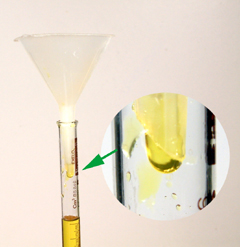
Funnel left in burette. This should be removed as it may drain and drip into the burette causing a change in the measured volume. |
|
|
|
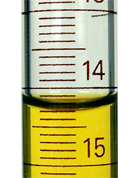
Mis-reading of burette. We always read to the bottom of the meniscus. Get down on a level with the reading to avoid parallax errors. Also take care with the scale - it runs from the top downwards. The reading in the photograph is 14.30 cm3, but it is sometimes read incorrectly as 15.70 cm3. |