ISSR CLASSES
Checkpoint Science
iGCSE Chemistry
iGCSE Physics
iGCSE Coordinated Science
A-Level Chemistry
PRACTICALS
Practicals Home
Practicals A-Z
Study Plan for Practical Work
You will need to work out an enthalpy change in kJ mol-1. This is done by dividing the heat energy (in kJ) by the number of moles (in moles).
The heat energy is usually worked out using the equation:
|
Heat energy (in J) = 4.18 × mass of solution (in g) × temperature change (in °C) |
4.18 is the specific heat capacity of water. We assume that the plastic cup and thermometer have no heat capacity (a small error). We consider that any solutions used are largely water (this is usually fairly accurate) and so will have the same heat capacity as water. You can also assume that 1 cm3 of aqueous solution will have a mass of 1 gram. So if you mixed two 25 cm3 volumes of solution then the mass used in the equation is 50 g. We assume that any solids used have no heat capacity and so are ignored. If you added 2 g of solid to 25 cm3 of solution, the mass used in the above equation is 25 g. Dividing the number of joules by 1000 will convert the value into kilojoules.
The number of moles used is calculated using the usual equations:
|
Number of moles (in mol) = concentration (in mol dm-3) × volume (in dm3) |
|
|
You must calculate the number of moles for the chemical which is not in excess. Not all of the excess chemical has reacted, so we know the total amount that we used but not the amount which has reacted. On the other hand, we know that all of the other chemical has reacted.
You may have to use Hess's Law to calculate your final answer.
Errors are an important part of these calculations. Check the error section so you know the accuracy of any measuring devices. It is best to use the digital thermometers which read to the nearest 0.1 ºC. You should be able to work out a percentage error based on the temperature change. For example, a 2.0 ºC temperature change would have an error of 0.1/2.0 × 100 = 5%. You should be able to do similar calculations with any other measurement.
Don't forget to include the correct sign with your answer. Exothermic reactions have a negative sign, endothermic ones have a positive sign.
|
Don't put in too many significant figures. Limit yourself to no more than one extra significant figure compared to the smallest number of significant figures that you started with. So in the above case, if the temperature change was the least accurate starting data (that is, had the least significant figures), then 2 sig. figs. (the same number) or 3 sig. figs. (1 extra) should be acceptable for the answer. If your temperature change is, say, 2.0°C, an answer like - 24 kJ mol-1 would be fine. |
|
Heat loss or gain is always a problem to be considered in calorimetry experiments. You may limit this error by using a cooling curve graph to determine the temperature change.
Example 1
20 cm3 of 1.00 M sodium hydroxide solution was mixed with 30 cm3 of 1.00 M hydrochloric acid in a polystyrene cup. The temperature rose from 18.7 ºC to 24.0 ºC. Calculate the enthalpy change for this reaction. Specific heat capacity of water is 4.18 J g-1 K-1.
The equation for the reaction is:
|
HCl(aq) + NaOH(aq) ⇒ NaCl(aq) + H2O(l) |
This shows a 1:1 relationship between the sodium hydroxide and hydrochloric acid. The two solutions have the same concentration, but as we have a larger volume of the hydrochloric acid this must be the reagent in excess. All the sodium hydroxide will be used up, so it is the number of moles of this which should be used in the calculation.
Number of moles of NaOH = 1.00 × 20/1000 = 0.0200 mol
The total mass of "water" is 30 + 20 = 50 g
The temperature rise is 24.0 - 18.7 = 5.3 ºC.
Heat evolved = 4.18 × 50 × 5.3 = 1108 J = 1.11 kJ
Enthalpy change = - 1.11/0.02 = - 55 kJ mol-1
The accepted value is - 57.9 kJ mol-1. Note the minus sign for the exothermic reaction (the temperature went up). Also note that we have given the answer only to two sig. figs. (the same as the temperature change). We can see from the accepted value that we would not be justified in using another sig. fig. (even our second sig. fig. is not correct!).
Example 2
25 cm3 of 1.0 M citric acid (C6H8O7) was reacted with 8.0 g of sodium hydrogencarbonate in a polystyrene cup. The temperature fell from 20.5 ºC to 4.9 ºC. Calculate the enthalpy change for this reaction. Specific heat capacity of water is 4.18 J g-1 K-1.
The equation for the reaction is:
|
C6H8O7(aq) + 3NaHCO3(aq) ⇒ C6H5O7Na3(aq) + 3H2O(l) + 3CO2(g) |
We need to work out which reagent is in excess, so we shall need to know the number of moles of each:
Number of moles of citric acid in solution = 1.0 × 25/1000 = 0.025 mol
NaHCO3 = 84
\ number of moles of solid NaHCO3 = 8.0/84 = 0.095 mol
According to the equation we need three times as much sodium hydrogencarbonate as citric acid. So we need 0.025 × 3 = 0.075 moles of NaHCO3. We actually have 0.095 moles, that is more than we need. So the NaHCO3 is in excess, so we need to use the number of moles of citric acid in our calculation.
Mass of water = 25 g (ignore the 8 g of solid sodium hydrogencarbonate, but see below)
Temperature change = 4.9 - 20.5 = - 15.6 ºC
Heat absorbed = 4.18 × 25 × 15.6 = 1630 J = 1.63 kJ
Enthalpy change = 1.63/0.025 = + 65 kJ mol-1.
The accepted value is + 70 kJ mol-1. Missing out the plus sign is very common, students even argue that they are right to do so! However, you will lose credit in your assessment if you do so.
We have assumed that the sodium hydrogencarbonate has zero heat capacity. It is interesting to note that this reaction actually makes more water. According to the equation C6H8O7 º 3NaOH, so 0.025 moles of citric acid will make 0.075 moles of water. This has a mass of 18 × 0.075 = 1.35 grams of extra water. This should really be added onto the original 25 grams in our calculation to give a better answer. However, we would not normally be this precise.
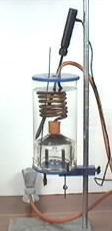
It is clearly not practical to measure the enthalpy change of a combustion reaction in a plastic cup calorimeter (it catches fire!). There are a number of types of apparatus which can be used to measure this enthalpy change. The following is a typical design:
|
|
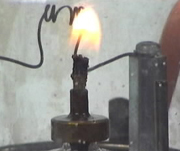
The spirit burner is filled with fuel and weighed. It is then lit and used to heat up the water in the calorimeter by around 10 ºC. The hot combustion gases are drawn through the copper tubing by attaching it to a vacuum tap or water pump. It can be tricky to get the suction at the right level. Too much suction and the burner blows out. Too little suction means not enough oxygen is drawn in, and the lamp goes out or burns poorly. The heat conducts through the copper and into the water. The water is stirred with the stirrer to ensure an even distribution of temperature. When the temperature change has been achieved, the lamp is blown out and reweighed. The difference in mass of the burner gives us the mass of fuel burnt, from which we can work out the number of moles. |
There are two ways of measuring the heat energy released by the combustion. Without changing the water, we can use the electric heater to heat up the calorimeter by the same temperature rise as that achieved using the burner. A joulemeter attached to the electric supply gives us a direct reading of the electrical energy used in joules. This is the method of electrical compensation calorimetry.
|
Alternatively, we can use another spirit burner which contains a fuel of known enthalpy of combustion. We obtain a similar temperature rise as before, and again measure the mass of the burner before and after combustion. Knowing the mass of fuel burnt, we can convert this to the number of moles. Knowing the number of moles burnt and the enthalpy of combustion, we can calculate the heat released on combustion. We can now calculate the heat capacity of the calorimeter (that is the heat required to raise its temperature by 1 ºC). Knowing the heat capacity of the calorimeter and the temperature rise obtained with the original fuel we can calculate the heat released in this part of the experiment. |
|
Both methods have the advantage that they compensate for heat loss. Heat lost to the surroundings during the first combustion part of the experiment should also be lost in the second part, and so be measured.
Example 3
A combustion calorimeter was heated up using a spirit burner containing propan-1-ol (DHC = - 2021.0 kJ mol-1). The burner weighed 12.472 g before combustion and 11.198 g after combustion. The temperature rose from 18.7 ºC to 27.9 ºC. An octan-1-ol burner was now used to raise the temperature of the same calorimeter from 25.2 ºC to 35.0 ºC. The mass of the burner fell from 13.741 g to 12.401 g during combustion. Calculate the enthalpy of combustion of octan-1-ol. What is the main error in this experiment?
Mass of propan-1-ol burnt = 12.472 - 11.198 = 1.274 g
C3H7OH = 60
\ number of moles of propan-1-ol burnt = 1.274/60 = 0.0212 mol
DHC = - 2021.0 kJ mol-1
\ energy released = 0.0212 × 2021.0 = 42.9 kJ
Temperature rise = 27.9 - 18.7 = 9.2 K
\ heat capacity of calorimeter = 42.9/9.2 = 4.66 kJ K-1
Temperature rise in octan-1-ol experiment = 35.0 - 25.2 = 9.8 ºC
\ energy released = 4.66 × 9.8 = 45.7 kJ
Mass of octan-1-ol = 13.741 - 12.401 = 1.340 g
C8H17OH = 130
\ number of moles of octan-1-ol burnt = 1.340/130 = 0.0103 mol
\ enthalpy of combustion of octan-1-ol = - 45.7/0.0103 = - 4400 kJ mol-1
You can find the same calculation, but with more explanation here.
|
The accepted value for the enthalpy of combustion of octan-1-ol is - 5239.6 kJ mol-1. We had rounded off our answer to allow for the limited accuracy of the temperature measurement (only two sig. figs.). However, there must be some other much bigger error(s) as our answer isn't even correct to one significant figure! We can see that our answer is much smaller than the accepted value. The most likely reason for this is incomplete combustion. It is difficult to get enough oxygen to the bigger octan-1-ol molecule, and the partial combustion is seen as it burns with a very yellow flame. This leads to the small numerical value measured. The equation for complete combustion is:
|
|
|
|
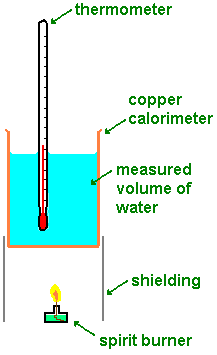
This is a simpler version of combustion calorimetry. We measure out a known volume of water and use the burner to heat it up. From the temperature rise we can calculate the number of joules absorbed by the water. Having weighed the burner before and after combustion we can calculate the mass, and hence the number of moles, of fuel burnt. This is a poorer method than before as it does not compensate for heat loss. |
Example 4
A simple copper calorimeter was filled with 200 cm3 of cold water. The temperature was 20.6 ºC. A spirit burner containing cyclohexane was weighed and found to have a mass of 13.289 g. After combustion the mass had fallen to 12.131 g. The highest temperature recorded was 39.8 ºC. Calculate the enthalpy of combustion of cyclohexane.
Mass of cyclohexane burnt = 13.289 - 12.831 = 0.458 g
C6H12 = 84
\ number of moles of cyclohexane burnt = 0.458/84 = 0.00545
Temperature rise = 39.8 - 20.6 = 19.2 ºC
|
Heat energy (in J) = 4.18 × mass of solution (in g) × temperature change (in °C) |
Heat absorbed by water = 4.18 × 200 × 19.2 = 16051 J = 16.1 kJ
\ DHc (cyclohexane) = - 16.1/0.00545 = - 2940 kJ mol-1
This compares to the actual value of - 3919.5 kJ mol-1. We see that there is quite a large difference caused largely by heat loss and incomplete combustion.
You can get some practice with calorimetry calculations in exercise 1, exercise 2, exercise 3 and exercise 4.
Exercise 5 is an example of a Hess's Law calculation.