ISSR CLASSES
Checkpoint Science
iGCSE Chemistry
iGCSE Physics
iGCSE Coordinated Science
A-Level Chemistry
PRACTICALS
Practicals Home
Practicals A-Z
Study Plan for Practical Work
For quantitative work (where we need to measure the volume of gas collected) we can collect the gas in a gas syringe.
Usually we need to collect a few test tubes full of gas. Most of the gases we deal with are colourless, which means they cannot be seen. This can make collection more difficult if you cannot see when your test tube is full of gas.
|
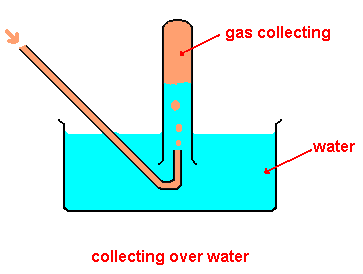
Collecting over water is usually the best method. A test tube is filled with water in a water trough. The gas is then introduced into the open end of the test tube using a delivery tube. As the gas fills the test tube it displaces the water, so it is easy to see when the test tube is full of gas. Never collect the first few bubbles that come out of the delivery tube, as air present in the apparatus first needs to be flushed through. |
|
A common misconception is that the gas rises up the test tube because it is less dense ("lighter") than air. However, it is not rising through air, it is rising through water, and it does so because it is less dense than water. As all gases are less dense than liquid water, they can all be collected in this way (but see below!).
A problem arises where the gas is soluble in water. Trying to collect these over water in not too clever (they dissolve!). The common soluble gases are ammonia, hydrogen chloride, hydrogen bromide, hydrogen iodide and sulfur dioxide. It is possible to collect these gases over different liquids - mercury metal is sometimes used. However, this is not common in schools and colleges.
|
|
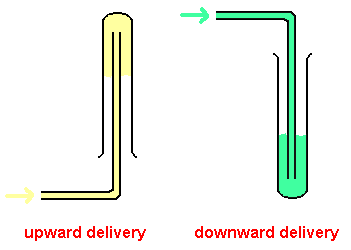
If the gas is soluble in water we usually resort to the methods of downward delivery and upward delivery. This simply involves pointing the delivery tube downwards into a test tube (downward delivery) or upwards into an upside-down test tube (upward delivery). The method chosen depends on whether the gas is heavier than air (use downward delivery) or lighter than air (use upward delivery). Make sure the delivery tube is inserted well into the collecting test tube. |
You can either learn which gases are more or less dense than air or you can work it out.
The difficulty with both upward and downward delivery is in deciding when the test tube has been filled with gas. It helps to have some sort of indication rather than just guessing. If the gas is acidic or alkaline, then a piece of damp litmus placed at the mouth of the test tube will show when the tube has been filled. Once the test tube has been filled it should be lightly stoppered. Whether the gas is more or less dense than air, it will escape fairly quickly by the process of diffusion.