ISSR CLASSES
Checkpoint Science
iGCSE Chemistry
iGCSE Physics
iGCSE Coordinated Science
A-Level Chemistry
PRACTICALS
Practicals Home
Practicals A-Z
Study Plan for Practical Work
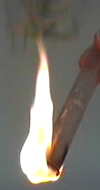
You should have noticed that the gas produced in this reaction burnt with a very sooty flame. It decolourised the orange bromine water and also decolourised the purple, acidified potassium manganate(VII) solution. If you have tried this last reaction yourself, you may find a brown solid produced. This is because the solution was not sufficiently acidified. These reactions are typical of alkenes. The alkenes are unsaturated hydrocarbons.
In the case of propan-1-ol, the alkene produced is propene:
|
|
When writing out these reactions be careful to remove the correct hydrogen atoms, as mistakes are often made here. The OH group is removed, and a hydrogen atom from a carbon atom adjacent to the carbon with the OH group.
The reaction is catalyzed by the aluminium oxide.
|
|
The combustion test is often used to indicate unsaturation. The presence of a double bond reduces the amount of hydrogen present in the molecule. This means that there is a greater proportion of carbon, and it is this carbon which produces the yellow, sooty flame. |
The two chemical tests above are frequently used in Chemistry (and in exams!) to indicate the presence of a multiple bond. Orange bromine water and purple, acidified potassium managanate(VII) are both decolourised when shaken with an alkene. It is important when doing these tests in practice, to use only small quantities of the solutions. Otherwise there will be insufficient propene gas to react with the solutions present, and it will appear to be a negative test.
Animation - the dehydration of propan-1-ol