ISSR CLASSES
Checkpoint Science
iGCSE Chemistry
iGCSE Physics
iGCSE Coordinated Science
A-Level Chemistry
PRACTICALS
Practicals Home
Practicals A-Z
Study Plan for Practical Work
In this experiment we use two important techniques to measure the order of the following reaction:
|
CH3COCH3(aq) + I2(aq) ⇒ CH3COCH2I(aq) + H+(aq) + I-(aq) |
Method 1
|
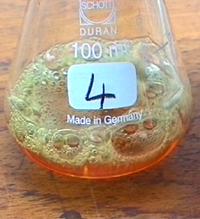
In method 1 we use the quench and titrate technique. A large batch of reaction mixture is prepared and at regular, timed intervals small samples are withdrawn. We then need to slow down the reaction (quench it) whilst we titrate it and measure the concentration. Quenching is often done by reducing the temperature. In this case, however, we add sodium hydrogencarbonate solution that removes the acid catalyst for the reaction - notice the effervescence in the video that follows. The titration is then performed, using sodium thiosulfate and starch indicator, to measure the concentration of the iodine throughout the reaction. |
 |
Drawing a graph of concentration of iodine against time, and looking at the shape of the graph enables us to determine the order of reaction. Watch the video for method 1 and collect the titre and time data. Draw a graph of titre against time and try to determine the order of the reaction with respect to the iodine from the shape of the graph. Why does the graph give the order of reaction with respect to the iodine, and not the propanone which is also changing in concentration? The reason for this is linked to the concentrations. You can check your answers by clicking on the results link below.
Method 2
In method 2 we use the method of initial rates. For this experiment the four experiment runs are shown in sequence speeded up to make the transition easier to see. It is quite difficult to estimate with any accuracy the time at which the colour disappears, but try to get as close as possible. You will see from your text book that the rate is proportional to the volume of iodine solution divided by the time taken for the colour to disappear. Calculate the four relative rates, and use these to work out the orders for both reactants and the acid catalyst. Hence, write down the rate equation for the reaction. You can check your answer by clicking on the link below.
|
Experiment |
Run A |
Run B |
Run C |
Run D |
|
Volume of 2 M HCl/cm3 |
20 |
10 |
20 |
20 |
|
Volume of 2 M propanone/cm3 |
8 |
8 |
4 |
8 |
|
Volume of water/cm3 |
0 |
10 |
4 |
2 |
|
Volume of 0.01 M iodine/cm3 |
4 |
4 |
4 |
2 |
Results and analysis - method 2
|
|
|
|
|