ISSR CLASSES
Checkpoint Science
iGCSE Chemistry
iGCSE Physics
iGCSE Coordinated Science
A-Level Chemistry
PRACTICALS
Practicals Home
Practicals A-Z
Study Plan for Practical Work
To write an ionic equation you need to be able to spot the ions in the equation. This is easy if we can see the charge written down, like Na+(aq). However, the charge is often hidden in an ionic compound where two oppositely charged ions cancel out. For example, NaCl(aq) is really a mixture of Na+(aq) and Cl-(aq). If you understand ionic formulae you should be able to spot the ions in a full equation. Don't make ions where there aren't any! Common compounds like H2O and CO2 are not ionic and elements like Zn(s), Cu(s), Na(s) are uncharged.
To construct an ionic equation take the full equation. For example:
|
Pb(NO3)2(aq) + 2KI(aq) ⇒ PbI2(s) + 2KNO3(aq) |
Look for the ionic compounds which are in solution (these are actually separate ions) and split these up into the oppositely charged ions:
|
Pb2+(aq) + 2NO3-(aq)+ 2K+(aq) + 2I-(aq) ⇒ PbI2(s) + 2K+(aq)+ 2I-(aq) |
Don't forget that strong acids are also fully ionised - it's not just metal/non-metal compounds. We have left the ionic solid unchanged as these ions are not separate (they are joined together in an ionic lattice). All that is left to do is to cancel out the aqueous ions which are present on both sides of the equation to give the ionic equation:
|
Pb2+(aq) + 2I-(aq) ⇒ PbI2(s) |
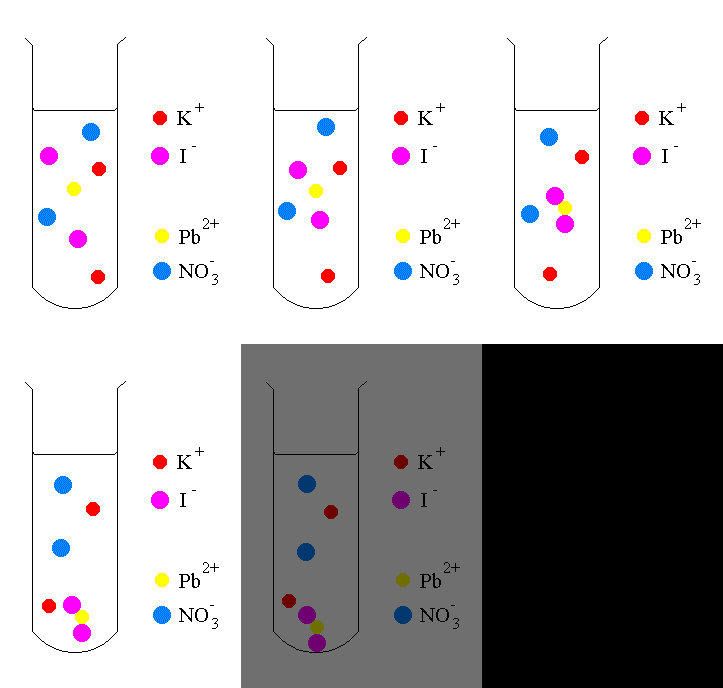
All that has happened in this reaction is that the lead(II) ions have met up with the iodide ions to form the solid precipitate of lead(II) iodide. This then sank to the bottom of the solution. The potassium and nitrate ions were in solution at the start, and are in solution at the end - they have done nothing. They are called spectator ions.
The following animation represents this precipitation process. You should see that the spectator ions jiggle about randomly during the process. The only real change which occurs is the coming together of the Pb2+ and I- ions:
Animation - the precipitation of lead(II) iodide