ISSR CLASSES
Checkpoint Science
iGCSE Chemistry
iGCSE Physics
iGCSE Coordinated Science
A-Level Chemistry
PRACTICALS
Practicals Home
Practicals A-Z
Study Plan for Practical Work
pH
The pH scale indicates the acidity or alkalinity of a solution. pH is defined by the equation:
|
pH = - log10[H+] |
In fact, pH is simply a measure of the hydrogen ion concentration in a solution (this is represented by [H+] in the equation above). It is the hydrogen ion which gives an acid its acidic properties. However, the hydrogen ion concentration is usually an inconveniently small number and would have to be represented using powers of 10. The -log10 part of the equation simply converts this number into a much more convenient number on the familiar 0 to 14 scale. It is technically possible for the pH to exceed these limits, and negative pHs are possible, but we don't usually meet them at "A" level.
So the pH scale is simply a numerical scale in a roughly 0 to 14 range which gives a measure of the hydrogen ion concentration. Note that a more acidic solution has a lower pH - a common error is to assume that acids will have larger pHs. pH is frequently written incorrectly by students it must have a small p and a large H. We shall meet the p prefix at other points in the course, it simply means - log10.
All aqueous solutions, including alkaline ones, contain hydrogen ions. Acid solutions have more hydrogen ions than hydroxide ions. Alkaline solutions have more hydroxide ions than hydrogen ions. Neutral solutions have equal numbers of hydrogen and hydroxide ions.
pH can be measured by looking at the colours of various chemical indicators or by using a pH meter. The pH meter is an electrical device and we shall see its principle of operation later in the course.
|
|
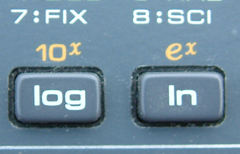
You might like to find the log key (log) on your calculator, be careful not to mix it up with the natural log key (ln). |