ISSR CLASSES
Checkpoint Science
iGCSE Chemistry
iGCSE Physics
iGCSE Coordinated Science
A-Level Chemistry
PRACTICALS
Practicals Home
Practicals A-Z
Study Plan for Practical Work
|
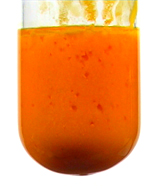
The carbonyl group is the C=O group. This group is found in aldehydes where it is on the end of the carbon chain. Aldehydes have the general formula RCHO. If the carbonyl group is not on the end of the carbon chain we have a ketone with the general formula RCOR'. We test for aldehydes and ketones using Brady's reagent, which you will meet in year 2. A positive result is the formation of a brightly coloured precipitate. |
|
Having established we have a carbonyl group, we can distinguish between aldehydes and ketones using either Benedict's solution or Fehling's solution. Another interesting test uses Tollen's reagent and is known as the silver mirror test. All three of these tests rely on the fact that aldehydes are very easily oxidized whereas ketones are not. Both Benedict's solution and Fehling's solution contain the blue aqueous copper(II) ion in alkaline solution. When heated with an aldehyde the blue copper(II) ion is reduced to a brick red precipitate of copper(I) oxide. Ketones are not readily oxidized so do not reduce the copper(II) ion, so the Benedict's or Fehling's solutions remain unchanged. A similar situation exists with Tollen's reagent, but this time we are dealing with the colourless silver(I) ion. In this case the aldehyde reduces the silver(I) ion to elemental silver which forms an attractive mirror on the side of the test tube. Again, the ketone has no effect.
|
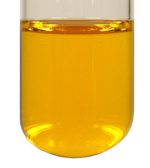
Using exactly the same oxidation principle, ketones have no effect when warmed with acidified sodium (or potassium) dichromate solution. Aldehydes are readily oxidized and so reduce the orange dichromate(VI) to green chromium(III). |
|