ISSR CLASSES
Checkpoint Science
iGCSE Chemistry
iGCSE Physics
iGCSE Coordinated Science
A-Level Chemistry
PRACTICALS
Practicals Home
Practicals A-Z
Study Plan for Practical Work
|
|
This reagent is used to distinguish between aldehydes and ketones. |
|
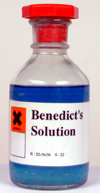
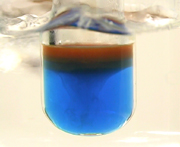
Benedict's solution contains the blue, aqueous copper(II) ion. This is a poor oxidizing agent. Ketones are not readily oxidized, but aldehydes oxidize very easily. Around a centimetre depth of Benedict's solution is placed in a boiling tube and a few drops of the suspected aldehyde are added. This mixture is then heated in a water bath. A positive test is given if an orange-red precipitate forms. The orange-red precipitate is copper(I) oxide, formed when the copper(II) ions were reduced on reaction with the aldehyde. The video below shows the reaction of Fehling's solution with glucose , a reducing sugar which contains an aldehyde group. Aldehydes, like propanal, give a less distinct change, but the brick red copper(I) oxide is still quite clear in the test tube after reaction. |
|
Video - a positive Benedict's test
An alternative reagent to Benedict's solution is Fehling's solution, or try the silver mirror test.