ISSR CLASSES
Checkpoint Science
iGCSE Chemistry
iGCSE Physics
iGCSE Coordinated Science
A-Level Chemistry
PRACTICALS
Practicals Home
Practicals A-Z
Study Plan for Practical Work
|
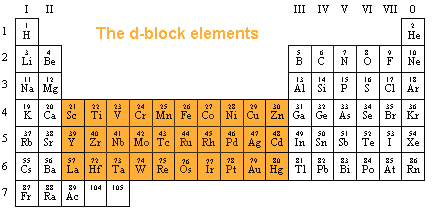
You should have already seen the structure of the Periodic Table, and may have noticed the central block of elements marked the d block. In this, the d electron sub shells are being filled. We are normally concerned with the first row of these in which the 3d shell is being filled (Sc to Zn). |
|
|
The transition elements are defined as those which have at least one compound in which the d shell is only part filled. |
Examples
Scandium only forms compounds in which it has the three plus ion:
|
Sc |
1s2 2s2 2p6 3s2 3p6 4s2 3d1 |
|
Sc3+ |
1s2 2s2 2p6 3s2 3p6 |
The compounds of scandium, therefore, have an unfilled d shell and so scandium is not classified as transition element.
|
Zinc only forms compounds which contain the two plus ion. You need to remember that the outer 4s electrons are removed before the inner 3d electrons (even though they were added before), so: |
|
|
|
Zn |
1s2 2s2 2p6 3s2 3p6 4s2 3d10 |
|
|
Zn2+ |
1s2 2s2 2p6 3s2 3p6 3d10 |
|
|
The compounds of zinc, therefore, have a filled d shell and so zinc is not classified as a transition element. |
||
|
Copper forms two groups of compounds, one containing 2+ ions and the other containing 1+ ions: |
|
|
|
Cu |
1s2 2s2 2p6 3s2 3p6 4s1 3d10 |
|
|
Cu+ |
1s2 2s2 2p6 3s2 3p6 3d10 |
|
|
Cu2+ |
1s2 2s2 2p6 3s2 3p6 3d9 |
|
|
In the copper(II) compounds the copper has a part filled d shell and so copper is classified as a transition element. |
||
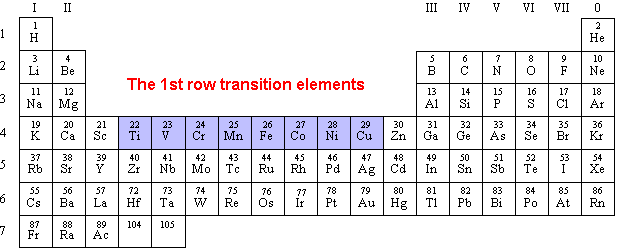
At "A" level we usually look at the elements titanium to copper, which are all transition elements:
There are a number of properties which are typical of transition elements:
1. All the elements have very similar physical properties
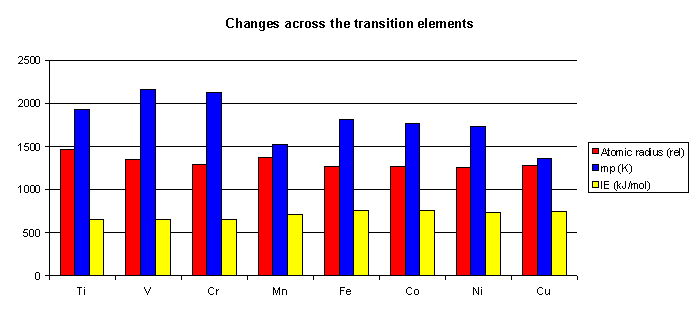
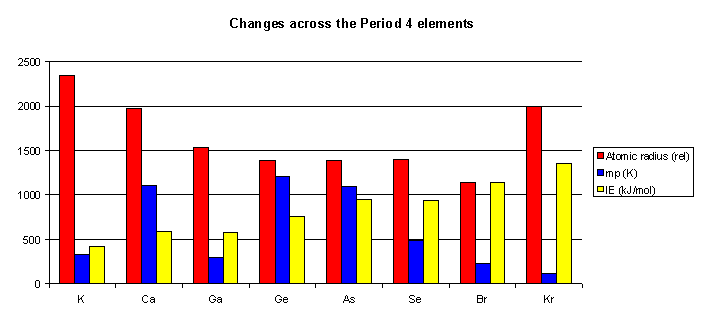
For example, they are all high melting point metals. This contrasts strongly with looking across a period from group 1 to group 8, where there is a major change in bonding behaviour and melting point. The reason for the similarity is that in moving across an extra electron is added to an inner shell (the 3d shell). It is always the outer electrons which dictate the properties of the element - those with one or two electrons are metals, those that are just one or two electrons short of a full shell are non metals. All the transition elements have one or two outer electrons (the 4s electrons). What is more, they are held into the atom with a similar force which means properties like atomic radius and ionization energy will be similar. The similar attraction is a result of the electrons being added to an inner shell. When we move from one atom to the next the outer electrons experience the greater pull of an extra proton in the nucleus, but this is virtually cancelled out by the extra repulsion of another electron in an inner shell (between the nucleus and the outer electrons).
Compare the following charts. The first one shows the similarities across the transition group. The second one shows the large changes which occur across a typical period (where the number of outer electrons change steadily).
2. Variable oxidation number.
This contrasts to the elements of groups 1 and 2 where the oxidation number in compounds is always +1 and +2 respectively. This was because there was an enormous jump in ionization energy when an electron is removed from an inner shell and so this does not happen. In contrast there is no large jump in ionization energy for the transition elements until all the 4s and 3d electrons are removed. This results in it being possible to have compounds in which different numbers of electrons have been removed from the transition element - that is variable oxidation number. It is worth knowing the most common oxidation numbers of the transition elements shown below:
|
(Sc) + 3 only |
Fe + 2, + 3 (others possible) |
|
Ti + 4 (others possible) |
Co + 2, + 3 (others possible) |
|
V + 2, + 3, + 4, + 5 |
Ni + 2 (others possible) |
|
Cr + 3, + 6 (others possible) |
Cu + 1, + 2 |
|
Mn + 2, + 4, + 7 (others possible) |
(Zn) + 2 only |
3. Formation of coloured compounds.
Again it is worth contrasting the ions of groups 1 and 2 which are all colourless. The transition elements form a variety of coloured compounds, some of which you know already. Energy in the visible part of the spectrum is absorbed by transition element ions when electrons jump from one of the d energy levels to another empty one. It is worth knowing some of the more common colours:
|
chromium(III) - green |
dichromate(VI) - orange |
|
chromate(VI) - yellow |
copper(II) - blue |
|
manganese(II) - very pale pink |
manganate(VII) - purple |
|
iron(II) - green |
iron(III) - yellow |
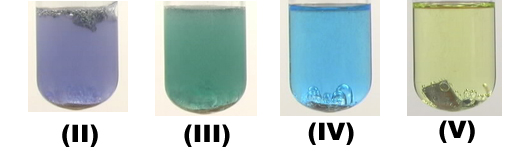
vanadate(V), VO2+(aq), is yellow, vanadate(IV), VO2+(aq), is blue
vanadium(III), V3+(aq), is green, vanadium(II), V2+(aq), is mauve
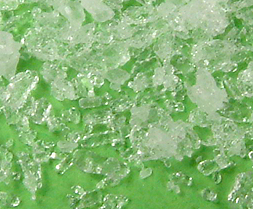
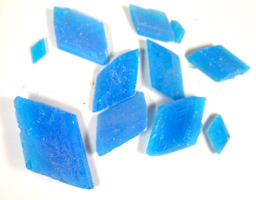
You should have noticed that in the two photographs at the start of the page the copper sulfate was coloured, but the zinc sulfate was not coloured. One of these metals is a transition element, one is not.
4. Formation of complex ions.
This is dealt with elsewhere. The incomplete d shell allows dative bonds to be formed to the ion from the ligands.
5. Catalytic activity.
Both the elements themselves and their compounds show a high degree of catalytic activity. It is worth reminding yourself of how catalysts work. A couple of examples follow. Iron metal catalyses the Haber process:
|
N2(g) +
3H2(g) |
and vanadium(V) oxide catalyses the Contact process:
|
2SO2(g) +
O2(g) |
You can see a number of transition metal reactions here.