ISSR CLASSES
Checkpoint Science
iGCSE Chemistry
iGCSE Physics
iGCSE Coordinated Science
A-Level Chemistry
PRACTICALS
Practicals Home
Practicals A-Z
Study Plan for Practical Work
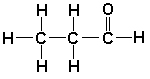
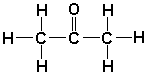
In this experiment we compare the reactions of an aldehyde, propanal, with a ketone, propanone. Both aldehydes and ketones contain the carbonyl group, C=O. The difference being that this group is terminal (on an end carbon) in aldehydes and not on the end of a chain in a ketone. Will this seemingly small difference have a significant effect on the reactions of these two similar-looking chemicals? Watch the videos and try to answer the questions. Check your answers in the theory link at the end.
|
|
|
|
propanal |
propanone |
1 Solubility in water
Would you expect propanal and/or propanone to be soluble in water? Try to draw a diagram showing a possible interaction between either a propanal or propanone molecule and a water molecule. You might want to review the theory of intermolecular forces.. The video shows water being added first to propanal and then to propanone.
Video - the solubility of propanal and propanone
2 Oxidation with sodium dichromate(VI)
In the video we attempt to oxidize the chemicals using a mixture of dilute sulfuric acid and sodium dichromate(VI) solution. Note down any colour changes and suggest the name and formula of any oxidation product.
Video - oxidation with sodium dichromate(VI)
3 Oxidation with Benedict's solution
Benedict's solution is blue as it contains the very mild oxidant, Cu2+(aq). This can be reduced to a brick red precipitate of copper(I) oxide. Is any change observed when it is used with the carbonyl compounds?
Video - oxidation with Benedict's solution
4 Oxidation with Tollen's reagent
Tollen's reagent is ammoniacal silver nitrate solution (that is silver nitrate solution mixed with ammonia solution). This reaction is used as a test for aldehydes. No reaction occurs with propanone, so the video only shows the change that occurs when propanal is heated in a water bath with Tollen's reagent.
Video - oxidation with Tollen's reagent
5 Reaction with Brady's reagent
|
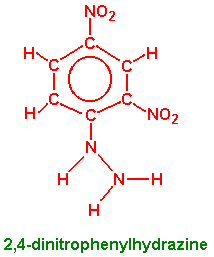
Brady's reagent contains 2,4-dinitrophenylhydrazine, and is used as a test for carbonyl compounds as a condensation reaction results in brightly coloured products. Given that the carbonyl group first adds to the 2,4-dinitrophenylhydrazine and then a small molecule is lost, suggest the structure of the products in each case. |
|
|
6 Reaction with iodine
You should see signs of a chemical reaction with both the propanal and the propanone. Given that hydrogen iodide is produced in each case, suggest equations for both reactions.
Theory - the reactions of carbonyl compounds