ISSR CLASSES
Checkpoint Science
iGCSE Chemistry
iGCSE Physics
iGCSE Coordinated Science
A-Level Chemistry
PRACTICALS
Practicals Home
Practicals A-Z
Study Plan for Practical Work
|
|
Ketones have a carbonyl group (C=O) which is not at the end of a carbon chain. This means that they have the general formula, RCOR' (where R and R' represents any group of carbon and hydrogen atoms). |
|
The simplest ketone is propanone (old name acetone). This is a useful solvent and is sometimes used as a nail varnish remover. Other ketones include cyclohexanone, and butane-2,3-dione which is a spoiling flavour in beer. Ketones are excreted in the urine of diabetics when fats are broken down for energy. |
|
Ketones can be prepared by the oxidation of a secondary alcohol. They are not readily oxidized, so do not react with Fehling's solution or Benedict's solution.
Ketones are given the suffix -ONE (pronounced "own"), giving names of the type alkanone . A number is usually needed here to identify the position of the group (unless there is only one possible position to place the C=O other than on the end).
Examples
|
|
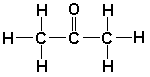
The structural formula is CH3COCH3. It is called propanone. There is no need for a number as the carbonyl group can only be in this place. If it were on the end it would be an aldehyde called propanal. However, you will probably not lose any credit if you do describe it as propan-2-one. |
|
|
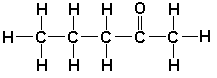
This time a number is needed as the carbonyl group could be in either positions 2 or 3. With 5 carbons, and counting to give the smallest number, this molecule is pentan-2-one. |
|
|
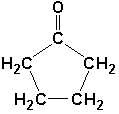
This is a cyclic ketone with five carbon atoms in it. It is called cyclopentanone. Unless there is another side group, there is no need for a number as all the positions are equivalent. |
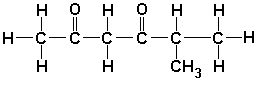
The structural formula is CH3COCH2COCH(CH3)2
This has two ketone functional groups and one methyl side chain. All need to be numbered correctly. Its name is 2-methylhexane-3,5-dione. As the d prevents a vowel clash we don't need to lose the e on the end of hexane.
See the practical of Unit 4.