ISSR CLASSES
Checkpoint Science
iGCSE Chemistry
iGCSE Physics
iGCSE Coordinated Science
A-Level Chemistry
PRACTICALS
Practicals Home
Practicals A-Z
Study Plan for Practical Work
|
Aldehydes have a carbonyl group (C=O) at the end of a carbon chain. This means that they have the general formula, RCHO (where R represents any group of carbon and hydrogen atoms). |
|
|
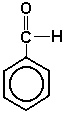
The simplest aldehyde is methanal (HCHO) which used to be known as formaldehyde. This is a gas, but dissolves to give an aqueous solution which is best known for its use in preserving biological specimens. Benzaldehyde (C6H5CHO) is a liquid which smells strongly of marzipan. It is used in artificial almond flavouring. |
|
Aldehydes are usually made by the oxidation of primary alcohols. They are readily oxidized to carboxylic acids. Aldehydes can be distinguished from ketones by a test with either Benedict's solution or Fehling's solution.
Aldehydes are named using the suffix -al, so the name is of the form alkanal. There is no need for any position number as aldehyde groups can only be on the end of the chain. Make sure your writing is clear as -al looks very similar to -ol (alcohol).
Examples
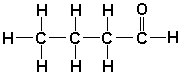
The structural formula is CH3CH2CH2CHO.
This has an aldehyde functional group (C=O on the end) and four carbon atoms in the chain. It is called butanal.
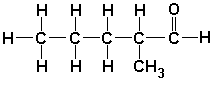
The structural formula is CH3CH2CH2CH(CH3)CHO
This aldehyde has 5 carbons in the longest chain. Be careful with the numbering. The aldehyde is assumed to be at carbon number one, so the methyl group is at carbon number two. This is called 2-methylpentanal.
|
|
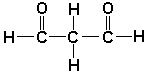
The structural formula is OHCCH3CHO There are three carbons in the chain and two aldehyde groups. This is called propanedial. The e returns as there is no longer a vowel clash. |
|
The only arene with an aldehyde group that you are likely to meet is benzaldehyde. The naming is different to the others, so it is worth learning. The alternative name, benzenecarbaldehyde, is rarely used. |
|
See the practical of Unit 4.