ISSR CLASSES
Checkpoint Science
iGCSE Chemistry
iGCSE Physics
iGCSE Coordinated Science
A-Level Chemistry
PRACTICALS
Practicals Home
Practicals A-Z
Study Plan for Practical Work
|
The alcohols are organic molecules which contain the -OH group. The most well known of the alcohols is ethanol, C2H5OH. This is the alcohol found in alcoholic drinks, and you may already be aware of some of its properties!
|
|
|
|
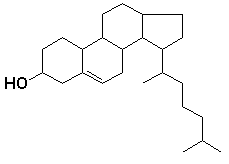
Methanol, CH3OH, is the simplest alcohol, it is poisonous through skin absorption and is added to methylated spirits to make it undrinkable. Ethane-1,2-diol (ethylene glycol), CH2OHCH2OH, is used as an anti-freeze. Propane-1,2,3-triol, CH2OHCHOHCH2OH, is glycerine, used to make cake icing and nitroglycerine! Cholesterol is a rather complicated alcohol found in the body, an excess of which can lead to blocked arteries and heart failure. |
|
|
Cholesterol |
Alcohols are classified as three types. You can find out about this here.
Alcohols are named using the suffix -ol, giving a name of the type alkanol. You may have to use the prefix hydroxy- if the end of the name is already taken up by another functional group.
Examples
|
|
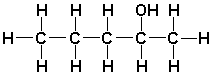
The structural formula is CH3CH2CH2CH(OH)CH3 There are five carbon atoms in the chain, and we number the chain so as to give the smallest number for the functional group. This gives us the name, pentan-2-ol. |
|
|
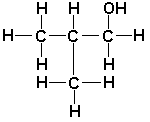
The structural formula is (CH3)2CHCH2OH This alcohol has a methyl side chain. It is called 2-methylpropan-1-ol. The 2- prefix is not strictly necessary as it couldn't be anywhere else. If we put the methyl on the end it becomes a chain of four carbon atoms, that is a butanol. |
|
|
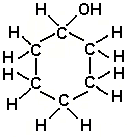
A six-membered ring is known as cyclohexane. So this molecule is cyclohexanol. There is no need for a number as all the positions are identical. |
|
|
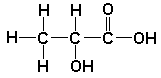
The structural formula is CH3CH(OH)CO2H The alcohol functional group has to be named using a prefix as the acid name is taking up the end position. This molecule is called 2-hydroxypropanoic acid (lactic acid). |
|
|
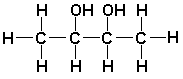
The structural formula is CH3(CHOH)2CH3 There are two alcohol functional groups, so this is known as a dihydric alcohol. The name identifies the four carbon chain, and the number and location of the two alcohol groups. It is called butane-2,3-diol. |
Take a look at the solubility theory and use it to decide which of the alcohols, methanol to butan-1-ol, will dissolve in water.
Look at the structure of the alcohol molecule. Do you think they are likely to release hydrogen ions (H+) making them acidic? Could they release OH- ions making them alkaline? Or will they release neither, making them neutral? Check your answers in the theory link.
Theory - solubility and pH of alcohols
Complete combustion produces carbon dioxide and water (and a lot of heat - alcohols are used as fuels). The smaller alcohols usually burn quite cleanly:
|
C2H5OH(l) + 3O2(g) ⇒ 2CO2(g) + 3H2O(l) |
but incomplete combustion may be a problem with the larger alcohols. Incomplete combustion produces carbon and carbon monoxide gas.
Watch the following video which shows a number of different alcohols reacting with sodium. What signs of reaction are there? Are the reactions similar for the different alcohols? What trend in reactivity is there and can you explain it? Try to write an equation for the reaction of sodium with ethanol. Check your answer in the theory link below.
Video - the reaction of sodium with alcohols
Theory - the reaction of sodium with alcohols
This reaction has a habit of bumping. Watch the video which shows the action of heating a mixture of orange sodium dichromate solution, dilute sulfuric acid and an alcohol. Alcohols in the range methanol to pentan-1-ol have been used. What signs of reaction can you see? Are the reactions similar for the different alcohols? Check your answer using the theory link below.
Video - oxidation of a range of alcohols
Observations and theory - oxidation of alcohols
This is a very lively reaction which produces hydrogen chloride gas so needs to be done in a fume cupboard. This gas can be tested for using ammonia gas. The reaction with phosphorus(V) chloride can be used to test for the presence of an OH group in an organic liquid. The reaction replaces the OH with a Cl making a chloroalkane:
|
C2H5OH + PCl5 ⇒ C2H5Cl + POCl3 + HCl(g) |
Video - the reaction of ethanol with phosphorus(V) chloride