ISSR CLASSES
Checkpoint Science
iGCSE Chemistry
iGCSE Physics
iGCSE Coordinated Science
A-Level Chemistry
PRACTICALS
Practicals Home
Practicals A-Z
Study Plan for Practical Work
We are normally concerned with solubility in water. However, we will occasionally have to consider the solubility of some substances in organic solvents like ethanol and cyclohexane. You can find solubilities in a book of data.
It is important to have an idea of which inorganic salts are likely to be soluble in water. Learn the solubility table and try the problems. This allows us to predict whether a precipitate will form when two salt solutions are mixed together.
Predicting the solubility of organic compounds in water is quite a popular exam question, and it helps in planning your own experiments.
|
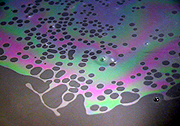
Water is a very polar solvent, and the general rule is that like dissolves like. In other words, polar compounds tend to dissolve in water, whereas non-polar compounds do not. Hydrocarbons are non-polar molecules. It is well-known that oil (which is composed largely of hydrocarbons) does not mix with water. These molecules are said to be hydrophobic (literally meaning water-hating). |
|
We shall need to be a little more precise for "A" level. Even when we are not dealing with the hydrocarbons themselves, we find that the hydrocarbon parts of organic molecules are also hydrophobic and will reduce the solubility of the molecule in water. This will make it insoluble, unless there are other polar parts of the molecule which increase the solubility. These other parts of the molecule are hydrophilic (water-loving). The most common hydrophilic group is the OH group. It is, perhaps, not surprising that this is attracted to water - given that water is simply made up of two OH groups. The reason that the OH group is so hydrophilic is that it can hydrogen bond to water. For the same reason, the NH bond is an excellent hydrophilic group. Any polar group will be hydrophilic, but not as much as those groups which can hydrogen bond. The C=O bond is a good polar group with only limited opportunity for hydrogen bonding (between the negative C=O oxygen atom and the positive hydrogen atom in water).
As a general rule (it doesn't always work!), one hydrophilic group, with some opportunity for hydrogen bonding, will make a hydrophobic group containing up to three carbon atoms soluble. It is very helpful to have an idea whether a compound will dissolve in water, but don't worry if you occasionally predict incorrectly. You can check in the data book, and you will always find out you were wrong when you try to mix them!
Try to work out the solubility in water of the following substances. Clicking in the appropriate boxes will reveal the solubility and the reason behind it.
|
Substance |
Formula |
solubility |
Reason |
|
Ethanol |
CH3CH2OH |
|
|
|
Glucose |
CH2OH(CHOH)4CHO |
|
|
|
Cyclohexane |
(CH2)6 |
|
|
|
Butanal |
CH3CH2CH2CHO |
|
|
|
Bromoethane |
CH3CH2Br |
|
|
|
Pentanoic acid |
CH3(CH2)3COOH |
|
|
|
1,6-diaminohexane |
NH2(CH2)6NH2 |
|
|
If the compound is not soluble in water, then we need to try a less polar solvent to make a solution. Ethanol or cyclohexane are good suggestions to try.