ISSR CLASSES
Checkpoint Science
iGCSE Chemistry
iGCSE Physics
iGCSE Coordinated Science
A-Level Chemistry
PRACTICALS
Practicals Home
Practicals A-Z
Study Plan for Practical Work
|
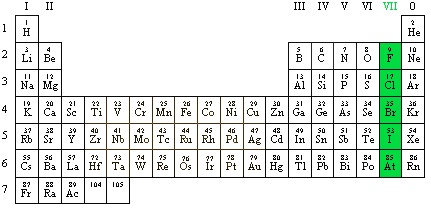
The halogens are the elements of group 7 - fluorine, chlorine, bromine, iodine and astatine. Fluorine is extremely reactive and astatine is rare, so at "A" level we only meet chlorine, bromine and iodine. |
|
Bromine is extracted from sea water. Sea water also provides much of the sodium chloride from which chlorine is obtained. Various minerals are the source of iodine and fluorine.
Fluorine is a pale yellow gas which is extremely reactive. Many substances burst into flames or explode in contact with fluorine. Note the difference between the element (fluorine) and the ion (fluoride) which is used in toothpaste. Because of its reactivity we do not meet fluorine at "A" Level. Try to spell fluorine correctly - it is often written incorrectly as flourine.
|
|
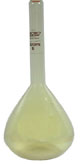
Chlorine is a pale green gas. It is also very reactive and toxic. It was used in the First World war as a poison gas and is met at low concentration in swimming pools to kill bacteria. You may deal with chlorine water. This is an aqueous solution of chlorine which appears colourless. |
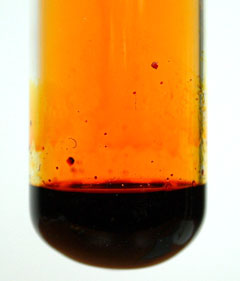
Bromine is a dark red-brown liquid which is very volatile so we also see a dark brown vapour. It is extremely corrosive. At "A" Level we usually meet bromine water. This is an aqueous solution of bromine which appears orange or yellow depending on the concentration of the bromine.
|
|
|
|
Liquid bromine with bromine vapour above |
A bottle of bromine water |
|
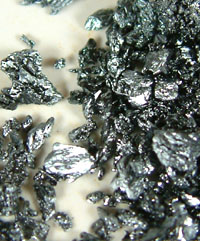
Iodine is complicated as we meet it in a number of different forms. Students often think it's a liquid because they have met this at school or even at home (where it is used as an antiseptic). However, this is a solution of iodine. The element iodine is a grey-black solid. |
|
|
|
Iodine is only very sparingly soluble in water, but dissolves readily in potassium iodide solution. Iodine in potassium iodide solution is the most common solution of iodine used in the laboratory. The solution is brown, or yellow if dilute. |
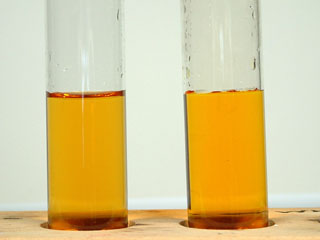
A problem can arise in identifying dilute solutions of the halogens. Dilute solutions of iodine and bromine are both yellow and very difficult to tell apart.
|
|
Look at the photograph on the left. Can you tell which is the iodine and which is the bromine? The two solutions can easily be distinguished by adding some hydrocarbon solvent and shaking the mixture. The hydrocarbon solvent is immiscible with the aqueous solution and floats on the top. The halogens are much more soluble in the non-polar hydrocarbon solvent than they are in the water. Bromine is orange in hydrocarbon solvent and iodine is purple. Put your mouse over the picture - it should now be fairly easy to tell which is which. Chlorine appears colourless in hydrocarbon solvent. |
|
Iodine is an unusual solid in that it sublimes at atmospheric pressure. This means that it does not melt to form a liquid, but changes directly from solid to vapour. Iodine vapour is violet. |
|
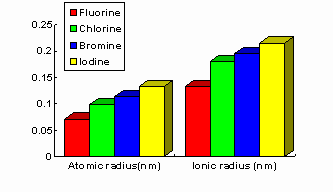
Whilst you won't meet astatine in your course, but you should be able to predict some of its properties (like its state) from the trend in the properties of the other halogens as we go down the group. You can see some trends in group 7 in the charts below:
 |
|
All the halogens are toxic and need to be handled with care.